
How to Stop Snoring: A Complete Guide to Quiet Nights
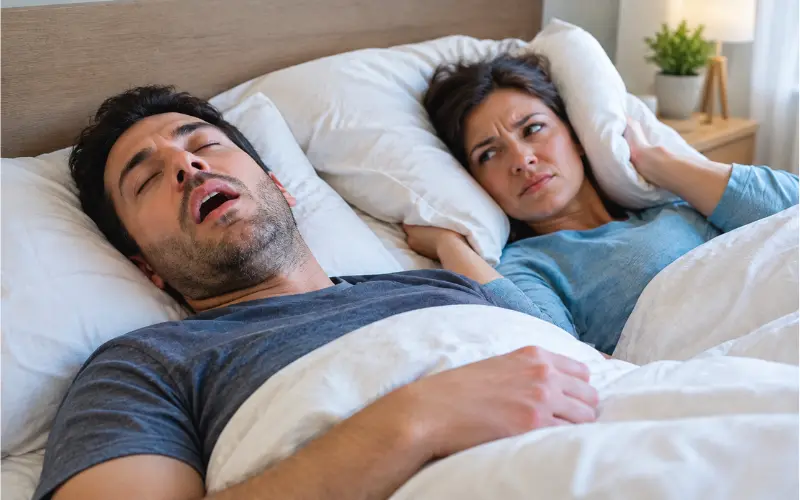
Snoring stops when air moves freely through your throat while you sleep. Sleep on your side, keep your nasal passages clear, lose a few pounds, avoid drinking before bed, and manage allergies. Do that, and the majority of snoring goes down. However, if it is loud every night or if you wake up gasping for air, don’t dismiss it. See a doctor and rule out sleep apnea.
With a few little changes, most people settle down. Some require a very basic device. Some require a procedure, and that’s okay as well. This guide takes you through everything from free fixes you can make tonight to surgery, so you can find the fix that fits your problem.
Key Takeaways
- Snoring occurs when the relaxed tissue in your throat vibrates as air rushes through the constricted airway.
- Most cases resolve spontaneously with side sleeping, weight loss, and a clear nose.
- If snoring is loud and is accompanied by choking or gasping, it may be obstructive sleep apnea (OSA). That’s a doctor’s job.
- Devices are effective if used appropriately for the cause. Nasal strips, oral appliances, CPAP.
- It is worsened by alcohol, smoking, and sedatives. You’ll notice the difference immediately after cutting them.
- If you snore and have trouble sleeping, or if your partner observes you stop breathing, you should get checked.
What Is Snoring?
Snoring is the loud noise you make when air passes over loose tissue in your throat and causes it to vibrate as you breathe while you’re asleep. That’s the tissue vibration that your partner has come to dread.
Consider what occurs when you fall into a drift. The muscles of the upper airway become floppy. The soft palate, uvula, tongue, and loose soft tissue at the back of the throat begin to droop and block the airway for air to pass through. The less space, the faster the air flows. That fluttering is what you hear when you snore, and it occurs because of faster airflow.
This is all within your respiratory system, and the area is known as the upper respiratory tract. If anything reduces that path, your chances of snoring increase, whether it’s a congested nose or a thick neck.
Types of Snoring
Not all snores are equal. Once you know your type and the right fix, it’s much easier to figure it out.
- Simple snoring (Primary snoring) is the condition of snoring without any breathing disturbances. This is a noise issue and not a health issue.
- Closed-mouth snoring typically begins with the tongue falling back. This is snoring through the tongue.
- Open-mouth snoring is tied to mouth breathing and is a clue to the throat. This group includes palatal snoring (from the soft palate).
- Nose-based snoring is caused by blocked nostrils, a deviated septum, or simply congested noses.
Know where the sound begins and you can go after the cause instead of guessing.
Snoring vs. Sleep Apnea
This is the most important part for health.
Sleep apnea is a condition in which breathing starts and stops during sleep. The most common kind is obstructive sleep apnea (OSA). Your airway collapses, and the flow of air ceases.
OSA causes apneas (complete pauses) and hypopneas (partial pauses). Doctors count these as apnea-hypopnea events. All those breathing stops cause your blood oxygen to decrease and your brain wakes you up enough to take a breath. You may choke, gasp, or snort yourself half awake without ever being aware of it. That decreased blood oxygen, night after night, wears down your heart.
The difference matters. Simple snoring is irritating. Sleep apnea is a serious condition. If you wake up gasping, or your partner sees you stop breathing, seek help.
What Causes Snoring?
Many things constrict your airway, and they often work together.
Anatomy. A long soft palate or large uvula obstructs the flow. A deviated septum or tight nostrils block off the nose. Kids snore because large tonsils, adenoids, or enlarged adenoids crowd their throat. A cleft palate and a small lower jaw set too far back combine with this condition. When the muscle tone in your throat is weak, it collapses inwards as soon as you relax.
Nasal issues. A blocked nose forces you to breathe through your mouth. When allergies, dust mites, pet dander, a common cold, or a blocked nose cause you nasal congestion, you must breathe through your mouth, which dries out everything and exacerbates the snore.
Body factors. The airway is compressed by a thickened neck. A bigger circumference of the neck and additional fat around the throat, close to the carotid artery, both compress the airway through which you breathe.
Habits. Alcohol, sedatives, and sleep deprivation make the throat too loose.
To keep it straight, doctors categorize the causes into nasal snoring, palatal snoring, or tongue snoring and treat the cause.
Risk Factors: Who Snores More?
Some people just snore more than others.
- Obesity and being overweight cause packing around the airway. The higher your body mass index (BMI), the greater your risk.
- Age and aging loosen the throat muscles over the years.
- Sex plays a part. Men snore more than women, but the difference between the two decreases with age.
- Snoring runs in families because of family history and hereditary factors that determine the type of airway you were born with.
- Weight and swelling during pregnancy. Throat tone changes due to menopause and hormonal changes. A general hormonal imbalance and hormone replacement therapy can give it a push.
- Smoking irritates and leaves airways swollen.
- Alcohol, tranquilizers, and sleeping pills relax the throat. Medications that affect the central nervous system, like lorazepam (Ativan) and alprazolam (Xanax), induce deep muscle relaxation, and that translates to a louder snore.
How Doctors Diagnose Snoring
The visit begins with a conversation and examination. Your doctor asks about your medical history and performs a physical exam, including an examination of your nose, mouth, and throat. They may assess your Mallampati score, which is a rapid assessment of the amount of throat that’s visible when you open your mouth wide. They might also take your neck circumference and BMI.
At times, they need a better understanding. An imaging test allows the doctor to view the inside of the airway, with the use of an X-ray, a computed tomography (CT) scan, or a magnetic resonance imaging (MRI).
If apnea is a possibility, you undergo a sleep study. Polysomnography is the gold standard and is performed overnight in a sleep center or sleep lab. It monitors a long list of activities during sleep: brain waves, blood oxygen level, heart rate, breathing rate, sleep stages, eye movements, and leg movements. Can’t face a lab? For many, a simpler home sleep test will work.
You can do some preparation in advance. Use a sleep diary, sleep tracking app, or set up a voice recorder that activates when you get noisy to help track how loud and how often you go. It’s a good first step to a diagnosis.
How to Stop Snoring Naturally
Begin here, as this is inexpensive and often it just works.
Adjust sleep position. Back sleeping allows your tongue to fall back. Side sleeping maintains the airway. If you want to be on the safe side, use the tennis ball trick (sew a ball in the back of your shirt so that you know you are rolling over) or wrap yourself around a body pillow. A good side sleeping pillow will support the neck, keeping the airway straight. One of the quickest fixes for most is fixing your sleep position and sleep posture.
Raise your head. Some elevation of the head allows gravity to work for us. A wedge pillow or adjustable bed can help with this, and a split king adjustable bed allows each partner to adjust their bed individually. Not ready to buy furniture? The right pillow height can make a difference, just for this.
Choose the appropriate pillow. The one that is not correct folds your neck and closes your throat. The type of stuffing material in the pillow determines how much your head will sink, so it’s worth getting acquainted with the various pillow stuffing materials before you invest a cent. The aim is to be firm and supportive. This will help to keep your neck in a straight line and your airway open.
Clear your nose. Use a humidifier to add moisture. Use a neti pot or saline flushing to remove the gunk. If you are truly congested, a brief period of use of a nasal decongestant or a nasal spray containing a steroid will help clear congestion. If it’s due to allergies, take an allergy medicine and remove dust mites and pet dander from the bedroom.
Fix your habits. These lifestyle changes are the most important. Losing weight reduces the amount of tissue around your throat, and even a small amount of weight loss can help to reduce the volume. Stop smoking as well, as quitting smoking will reduce the swelling in the airways within weeks. Avoid drinking alcohol for a few hours before sleep. Avoid sedatives and sleeping pills unless prescribed by your doctor. And maintain sleep quality by getting the recommended amount of sleep (7-9 hours for most adults).
Do you have to share a room while you’re working it out? For now, a white noise machine or sound machine can save your partner’s sleep, or a set of earplugs.
5 Tips to Stop Snoring Naturally
Short on time? Here we list the five most effective natural tricks, from most impactful to least. Each one provides you with an activity to do tonight.
- Sleep on your side, not your back. The number one trigger is sleeping on your back, as your tongue and soft palate fall back the instant you lie down. This one change alone often eliminates snoring. Use a body pillow or the tennis ball trick to stay off your back until morning.
- Lose 5 to 10 percent of your body weight. There is no requirement to achieve a certain number. A reduction of only 5-10% reduces the fat around the throat and neck and expands the airway. This is the one that seems to work.
- Stay hydrated all day. If you are dry, the mucus in your nose and throat will be thick and sticky, and the sticky tissue will vibrate harder. Drink about eight glasses of water per day. In hot and dry weather, drink a little more.
- Rinse and steam your nose about 30 minutes before bed. Rinse with saline or steam for 10 minutes, and it will clear the passages and allow air to flow freely when you are down. Do it BEFORE you lie down, not after. This will keep your nose open as you sleep.
- Cut off alcohol and heavy meals 3 hours before bed. Alcohol relaxes the muscles of the throat, and food in the stomach pushes against the windpipe. Stay away from both of them before bedtime, and your muscles will remain firm where it matters.
Give all five a fair 2 weeks. By then, most mild snorers hear a difference, and it’s all free.
How to Stop Snoring Without CPAP: Devices and Aids
Many people prefer to have a quiet night without putting on a machine. These resources can help.
Nasal aids. Nasal strips are designed to open up the nostrils from the outside. An external nasal dilator is an alternative. An internal nasal dilator is used instead—all nasal dilators target snoring that occurs through the nose.
Oral appliances. Oral appliance therapy involves wearing a dental mouthpiece that moves your jaw or tongue. The most popular one is a mandibular advancement device (MAD), also known as a lower jaw-positioner, that moves the lower jaw forward. A tongue-retaining device (TRD) is different and helps to keep the tongue in place. Want the best fit? A dentist can custom-fit a mouth guard or dental device that works better than anything you can purchase over the counter and will last much longer.
Support gear. A chin strap keeps your mouth closed and prevents open-mouth snoring. The same applies to mouth taping, but use with caution and discontinue after the second breath becomes difficult. Some people go for a mouth spray, an oral shield, or other over-the-counter products that coat the throat. If position is your problem, you should look up the best pillows to reduce snoring, which anti-snoring pillows shape to prevent snoring.
Not sure which one to go for? This table makes it clear.
|
Option |
How it helps |
Best for |
|---|---|---|
|
Nasal strips / nasal dilator |
Open the nostrils |
Nose-based snoring |
|
Mandibular advancement device |
Moves lower jaw forward |
Tongue and jaw snoring |
|
Tongue-retaining device |
Holds tongue forward |
Tongue-based snoring |
|
Chin strap / mouth taping |
Keeps mouth closed |
Open-mouth snoring |
|
Anti-snoring or wedge pillow |
Aligns neck, raises the head |
Position-related snoring |
|
CPAP machine |
Pushes air to hold airway open |
Sleep apnea |
CPAP and Positive Airway Pressure Therapy
CPAP (Continuous Positive Airway Pressure) is the best treatment for sleep apnea. A CPAP machine pumps constant air into a CPAP mask that keeps your airway open throughout the night. This positive air pressure therapy eliminates snoring and the pauses in a single stroke.
It is not used for just snoring. But for OSA, it saves your heart, your energy, and your concentration. The mask is initially uncomfortable. After a few weeks, most people don’t even notice it.
Throat and Mouth Exercises to Stop Snoring
You can actually exercise the muscles that keep your airway open. This is myofunctional therapy, and it is based on oropharyngeal exercises.
The idea is simple. These throat exercises and mouth exercises tone the tongue and palate to prevent a slack mouth and tongue at night. Popular anti-snoring throat exercises include sliding your tongue back along the roof of your mouth, pressing your tongue up hard, and drawing out long vowel sounds out loud.
Music is a help here too. Singing strengthens the throat, as do wind instruments. A saxophone, flute, clarinet, or trombone all use the same muscles. Do it every day. After a couple of weeks, you will see a difference.
How to Stop Snoring Permanently: Surgery Options
If nothing else helps, or a real physical block is the problem, then surgery can be the final solution. Most of these are upper airway surgery.
- Uvulopalatopharyngoplasty (UPPP) takes out extra tissue from the throat and palate.
- Laser-assisted uvulopalatoplasty (LAUP) involves the use of a laser to remove the soft palate and uvula.
- Radiofrequency ablation (also known as radiofrequency tissue ablation or radiofrequency palate surgery) reduces tissue by heating it. The principle of somnoplasty is the same as thermal ablation palatoplasty (TAP).
- Injection snoreplasty is an injection that makes the palate stiffer. Uvuloplasty is a procedure to modify the uvula.
- The Pillar procedure involves inserting small rods into the palate to strengthen it.
- Children often have large tonsils and adenoids removed (tonsillectomy and adenoidectomy).
- Septoplasty is a procedure to realign a deviated septum to open the nose.
- Maxillomandibular advancement (MMA) is a procedure that advances the lower jaw and upper jaw to increase the size of the airway.
- With hypoglossal nerve stimulation, a surgeon places an upper airway stimulator device that gently stimulates the hypoglossal nerve, keeping your tongue held forward during sleep.
Doctors use local anesthesia for small procedures. Larger procedures require general anesthesia. For any decision you’re considering, discuss the potential risks with your surgeon before you make a decision.
Health Risks of Ignoring Snoring
Snoring isn’t always harmless. Apnea is especially serious if left untreated.
Disrupted sleep makes you feel sleepy during the day, tired all the time, and causes morning headaches. Push it for years, and apnea increases the risk of high blood pressure, also known as hypertension, as well as type 2 diabetes, stroke, and heart disease. This nighttime reduction in blood flow and oxygen puts stress on your whole body.
There are also fewer expenses. Mouth breathing gives you a dry mouth and sore throat in the morning. Some people experience excessive salivation and drooling. Oral appliances can cause jaw pain, tooth pain, teeth moving, and other dental issues if they don’t fit well, so fit is important.
When to See a Doctor
Consult a health care provider if your snoring is loud most nights, if you feel tired all day, or if your partner observes you gasping or stopping breathing.
Where do you start? Your primary care doctor or general practitioner is the place to start, and they can send you on to a sleep specialist for a sleep study. For nose and throat blockages, you want an otolaryngologist (ENT), also known as an ear, nose and throat doctor or head and neck surgeon. Looking for an oral appliance? It’s a dentist or dental specialist’s job.
A word of caution. Exercise caution with alternative medicine, homeopathy, and unproven pills. Some OTC products are helpful. Many do nothing. As research studies continue to emerge, consult with your physician about what is right for you.
Conclusion
So now you know how to stop snoring, from free habit changes to devices, exercises, and, if it comes to it, surgery. Start small. Sleep on your side, adjust your pillow, clear your nose, and avoid any drinks before bed for two weeks. Use a sleep diary or an app to monitor it to see the difference. If the loud snoring or gasping persists, see your doctor and request a sleep study. One simple step is all it takes to make your nights quiet tonight.
Frequently Asked Questions
Yes, if it is simple snoring. Many cases are cleared up with side sleeping, weight loss, a clear nose, and less alcohol. If the snoring is due to apnea or because of your anatomy, you may require a device or surgery.
Turn on your side. Use a wedge pillow to prop up your head. Use saline to flush your nose. Avoid a beverage before bedtime. These four provide immediate assistance.
It helps a lot. Any excess fat around the neck compresses the airway, and losing even a few pounds can help to increase the volume and improve sleep.
Not always. Apnea is indicated by loud snoring and gasping, choking, or pauses in breathing and is confirmed by a sleep study. Simple snoring is quiet and steady snoring.
They do, for a good reason. Nasal strips are good for nasal snoring. Oral appliances are suitable for tongue and jaw snoring. CPAP is the best treatment for sleep apnea. Correlate the tool with the source.
Yes. The throat muscles are toned daily with myofunctional therapy, singing, or a wind device. Simply wait a few weeks before you make a decision.