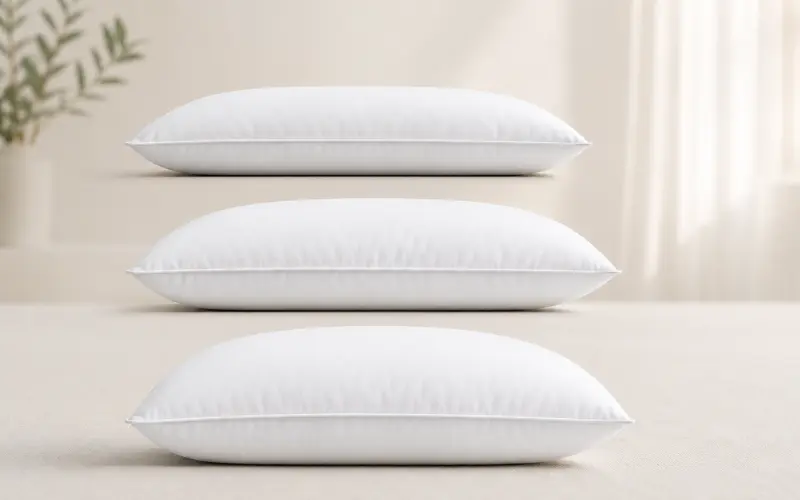
How to Choose a Pillow: A Tested 4-Step Guide(2026)
Quick answer: Select a pillow in 4 steps. Firstly, your sleeping position. Second, the height or loft (2-3 inches for stomach sleepers, 3-5 inches for back sleepers, and 5-6 inches for side sleepers). Thirdly, its hardness. For most, a medium-firm mattress is a good fit. Fourthly, the filling determines the gel’s feel, heat, and duration. Begin with the sleeping position. A good pillow will keep the head, neck, and back aligned.

You sleep on a pillow for about 2,500 hours a year. But most will purchase the one that feels soft in the store. If it is the wrong pillow, it can lead to a sore neck, poor sleep, and waking up tired in the morning. This guide outlines the four important factors and the order in which to consider them. Would you rather have the picks? See our best pillows guide.
How We Tested
We’ve tried over 45 pillows in our team! We have tried each sleep position and each filling. We tested three aspects of each: its ability to maintain its height through the night, whether it was hot or cold, and whether it maintained the neck in line. It’s advice from that and not from product labels.
The 4 Things That Decide Your Pillow
Your sleep position, pillow height (loft), firmness, and filling determine four key aspects of your pillow. They work together. The down pillow is soft and low. Latex pillows are firm and elevated. Your selection of filling already indicates a height and firmness.
|
What to pick |
What it controls |
The short version |
|---|---|---|
|
Sleep position |
The gap between your ear and the bed |
Pick this first. It sets the rest. |
|
Height (loft) |
How high your head sits, in inches |
Side high, back medium, stomach low |
|
Firmness |
Whether the pillow stays high all night |
Medium-firm fits most people |
|
Filling |
Feel, airflow, and how long it lasts |
Foam = support, down = soft, latex = lasts |
Begin with sleep position. The one choice reduces your other options by approximately 60%. From then on, it’s just fine-tuning.
Step 1: Choose by Sleep Position
The position you sleep in is most important. It determines the distance between your ear and the bed. Your pillow must fill this space!
|
Sleep position |
Gap to the bed |
Best height |
Firmness |
Best fillings |
Avoid |
|---|---|---|---|---|---|
|
Side |
4 to 6 in |
5 to 6 in (high) |
Medium-firm to firm |
Memory foam, latex, gusseted |
Thin, soft pillows that let the head drop |
|
Back |
medium |
3 to 5 in (medium) |
Medium |
Curved memory foam, down-feather blend |
Tall, hard pillows that push the chin down |
|
Stomach |
smallest |
under 3 in (low), often ~2 |
Soft |
Down, down-alternative, feather |
Memory foam, latex (too high) |
|
Combination |
changes |
4 to 5 in (medium) |
Medium |
Adjustable or shredded fill |
Pillows with a fixed height |
Side sleepers
The widest space is between the knees of side sleepers. The pillow should be high and medium-firm to firm, and hold your nose in line with your chest. The memory foam and latex mattresses performed the best in our tests. Soft fillings were too deep. Pillows that have a side panel (gusseted) maintain their height better. A wide shoulder starts at 5″ of height if the shoulder is over 18″ wide. For our tested picks, see the top pillows for side sleepers.
Tip: Place a small pillow between your knees to keep your hips aligned.
Back sleepers
A medium-sized pillow (3–5 inches high) is appropriate for back sleepers. It should outline your neck without dropping your chin. Our testers did not roll over with the inclusion of a dip in the middle and raised edges of the pillow. If you snore, increase your height by one inch. Elevating the head slightly may aid in breathing. See our picks for back-sleeper pillows to compare options.
Stomach sleepers
The stomach is the most difficult sleeping position. Your head turns to one side and your neck twists. The thinnest and softest pillow possible is required, less than 3 inches and closer to 2 inches. A few people fare better without a pillow. Feather, down, and down-alternative pillows are too thin. Memory foam and latex are too high. In our group, many stomach sleepers were using pillows that were too thick.
Step 2: Choose by Height (Loft)
When it’s flat, the thickness of your pillow is called the height, or loft. Though people tend to forget, it does the most to prevent neck pain.
|
Height |
Inches |
Best for |
|---|---|---|
|
Low |
under 3 in |
Stomach sleepers, lighter people, back sleepers on very soft beds |
|
Medium |
3 to 5 in |
Most back sleepers and combination sleepers. The safest pick. |
|
High |
5 in and up |
Side sleepers and wide shoulders. A gusseted pillow holds it better. |
How to measure height in 30 seconds: Lying flat (as in sleeping) against a wall. Have someone measure the distance from the outside of your head to the wall. This is your optimum height. This is also one thing that will change with your mattress. A soft mattress allows your shoulder to dip so that you can use a lower-height mattress. A hard mattress isn’t enough; you need something softer. If you prefer not to measure yourself, use our pillow height calculator to find the ideal loft range for your sleeping position and mattress size in seconds.
Step 3: Choose by Firmness
The firmness will determine whether your pillow maintains its height throughout the night or collapses.
- Soft: Easily compressed and has a soft feel. Perfect for stomach sleepers and those who prefer to sink in. Down and soft polyester is soft. These degrade the fastest and should be replaced every 12-18 months.
- Medium: Suitable for both back and combination sleepers. Carries your head without raising it. Medium shredded memory foam and down-feather. During our testing, these were the longest-lasting across most body types.
- Firm to extra-firm: Keep your head up and in place. Good for side sleepers with wide shoulders and for those who suffer from neck pain. Latex, solid memory foam, and buckwheat are firm.
For neck pain, most experts recommend a medium-firm to firm pillow with a curve. Firmness is most important if you wake up feeling sore.
Step 4: Choose by Filling
The filling determines the feel, breathability, and duration of a pillow. Here are the most common combinations that were tested in our tests.
|
Filling |
Feel |
Support |
Cooling |
Lasts |
Best For |
|---|---|---|---|---|---|
|
Solid memory foam |
Slow sink, shapes to head |
High |
Poor (holds heat) |
2 to 3 yrs |
Pressure relief, neck pain |
|
Shredded memory foam |
Moldable, adjustable |
Med-high |
Fair (some airflow) |
2 to 3 yrs |
Adjustable height, value |
|
Down / feather |
Plush, fluffy |
Low to med |
Good |
~1 yr (needs fluffing) |
Stomach and soft sleepers |
|
Latex |
Bouncy |
High |
Good to great |
3 to 4 yrs |
Lasts long, hot sleepers |
|
Buckwheat |
Firm, shifts around |
Very High |
Great |
3+ yrs |
Most support, cool sleep |
|
Polyester |
Soft, light |
Low |
Poor |
~1 yr (goes lumpy) |
Tight budgets, guest beds |
When the memory foam warms up, it conforms to your head. Solid foam provides constant support that heats up. Shredded foam is breathable, and the stuffing height can be adjusted. If this is your kind of feel, see the best memory foam pillows we’ve tried. Down and feather provides this hotel softness. Down is soft; feathers provide shape. Down is not ideal for dust allergy sufferers, unless you invest in a cover. Rubber tree sap is used to make latex. It’s springy, refreshing, and durable. Buckwheat is firm, fully adjustable, cool, and it makes a “rustling” noise. Polyester is the least expensive of the fibers, and the first to lump.
Choose by Budget
Not all pillows are created equal and they don’t always come with a high price tag. Here are what each price includes.
|
Budget |
What you get |
Replace every |
Note |
|---|---|---|---|
|
Under $50 |
Polyester or basic down-alternative, cotton or microfiber cover |
12 to 18 months |
No real latex or goose down here |
|
$50 to $100 |
Shredded memory foam, good down-feather, basic latex, gel cooling, zips you can adjust |
2 to 3 years |
Best value for most people |
|
Over $100 |
Solid latex, high-grade down, special foam, gusseted covers |
3+ years |
Worth it for pain or hot sleepers |
During our testing, those who had the best sleeping experience were those who chose their pillow based on their body shape rather than the price. You should take a $60 shredded-foam pillow that fits you, rather than the $200 down pillow that doesn’t.
Choose by Special Need
For anyone with a special need, the decision is easier. Begin with the need, then select the filling and height.
- Neck pain: Neck pillow with a medium to firm (preferably curved) pillow with raised edges and a depression in the center. After 2 or 3 nights, our testers reported less morning stiffness. See our guide to pillows for neck and shoulder pain.
- Pregnancy: A full-length C-shaped or U-shaped body pillow supports the belly, back, and knees of a pregnant woman. Ideal for side sleeping; doctors typically recommend it during pregnancy. Choose a washable cover and a soft and gentle fill. See the best pregnancy and maternity pillows for tested shapes.
- Hot sleepers: Latex, buckwheat, and gel shredded foam stayed coolest. Stay away from solid memory foam and polyester. Carry in a bamboo, linen, or cotton box.
- Allergies: Most pillow allergies are caused by dust mites. They are resistant to latex and solid memory foam. For a pillow cover, if you prefer, opt for a zip-up cover. Change the pillow every 18-24 months; wash the cases weekly.
Find Your Pillow Tonight
There is no need to make assumptions. The first thing to do is to begin with how you sleep. Match the height. Choose a firmness that will contain it. After you select your budget and any special needs, select a filling. If you sleep on your side, lift the mattress high and make it firm. If you are a back sleeper, get the medium size. Sleepers who sleep on their stomachs must use thin, soft pillows. Choose your filling based on pain, heat, or allergies.
Want to buy? Browse our complete best-pillow guide for tested picks with real ratings.
FAQ
Choose 4 steps. Firstly, your sleep position. Second, the height: low for the stomach, medium for the back, and high for the side. Thirdly, a strength sustaining that elevation. Fourth, a filling that is affordable and that meets any health requirement.
The ideal pillow is the one you sleep on. For people who sleep on their sides, it is best to use a firm, high pillow. A medium-firm mattress is best for back sleepers. Stomach sleepers should opt for a thin and soft one. Next, choose a filling that is both affordable and suits your health requirements.
Have your sleeping position tell you what you need. Soft for stomach sleepers, medium for back sleepers, and firm for side sleepers. More heavy individuals tend to be one step harder. If you wake up with a “flattened” head, press harder. When your neck feels supported, move downwards.
Under 3” stomach sleepers. Back sleepers, 3-5 inches. Side sleepers that are 5 to 6 inches. The easiest way to determine yours is to lie against a wall and measure from the wall to the side of the head.
Latex, buckwheat, and Gel shredded foam remain the coolest. Solid memory foam and polyester retain the most heat. The bamboo or linen case is a couple of degrees cooler than a cotton case.
A medium firm contoured pillow, such as a memory foam or latex pillow, is often recommended by doctors and physical therapists. The raised edge and dipped centre help support the natural curve of the neck, maintain spine position, and can help minimise stiffness or headaches in the morning.