Pillow Fill Types: 11 Options Compared (2026 Guide)
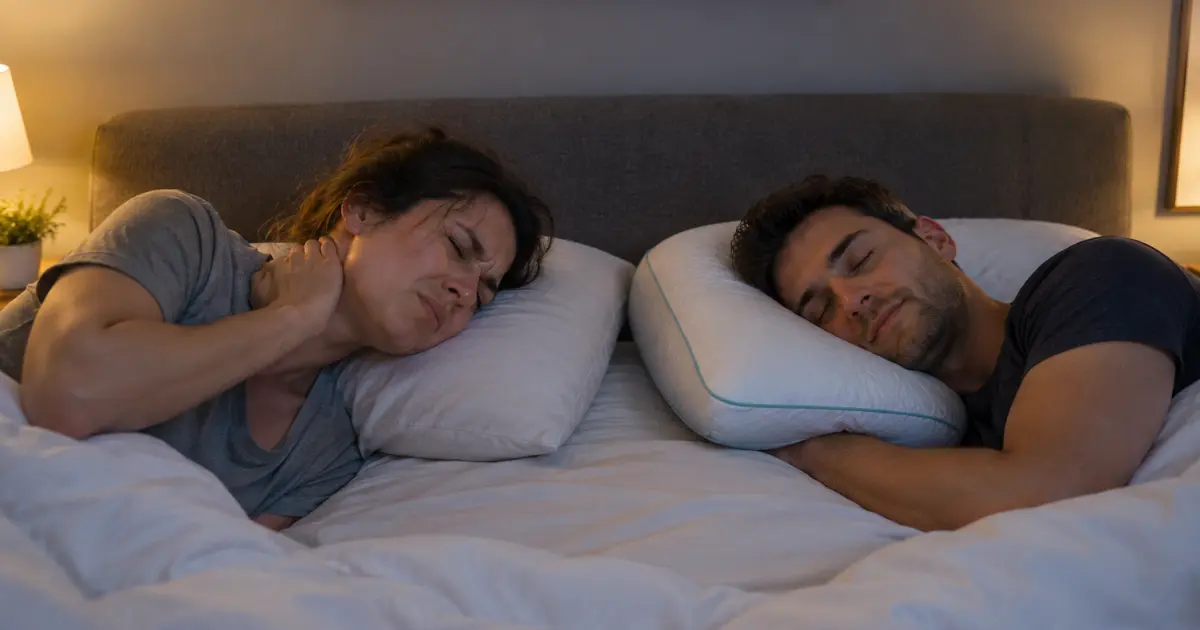
Most people look for pillows by squeezing them in a retail aisle. That test is of little use. The type of pillow fill concealed inside the cover determines the sensation of the pillow the first time you put it to bed, at night when your head and neck need support, how warm it will be while you’re sleeping, and if it will last through the wash.
We explain all 11 common types of fills, ranging from goose down to buckwheat hulls, which helps you compare the material to your body and budget before you consider the first brand. If you’re aware of which type of fill you prefer, our list of the best pillow brands can help you narrow down your choices.
What Is a Pillow Fill Type?
The stuffing found inside the exterior shell of a pillow is called the pillow fill type. It affects the loft (height), firmness, breathability, weight, durability, and cost of the pillow. Down or feathers, memory foam, latex, polyester fiberfill, buckwheat hulls, Kapok, wool, and cotton are common types of fills. The various materials all support your head and neck differently.
The fill is more important than the cover as it performs the structural function. A cotton pillowcase is on your skin, but it is the fill that determines if your spine is in the correct alignment or if you have a pillow lump in the morning. Two pillows made with the same pillow cover may seem the same, but they may feel entirely different if one has shredded latex and the other has polyester.
Fill also contributes to the maintenance. Some materials can withstand the washing machine. Others disintegrate when watered. Buyers can avoid the entire hassle of purchasing an upholstery with a high fill, which they would end up paying $150 for on laundry day.
What Are the Main Pillow Fill Types?
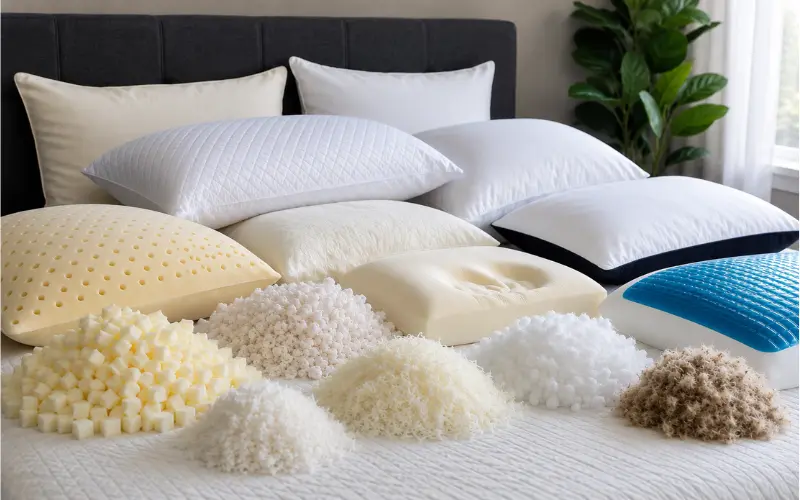
Pillow filling materials include down, feather, down alternative, memory foam, latex, polyester fiberfill, buckwheat hulls, Kapok, wool, cotton, and microbeads. Down lasts the longest, and so does latex. Polyester is the least expensive. Buckwheat sleeps the coolest. Memory foam conforms the most. It depends on the sleeping position, temperature, and allergies you have.
1. Down
Down does not come from the outside covering of geese and ducks, but from the fluffy undercoating. It has no quills, making it soft and moldable like sinking into a cloud for a pillow. Goose down is larger than duck down, making goose pillows more lofty and more expensive.
Manufacturers design these for those who sleep on their stomachs or prefer to cradle a pillow under their head. Manufacturers have made them with little bounce and generally too flat for side sleepers with wide shoulders without overstuffing them. Down also retains heat, the advantage hot sleepers regret, but cold sleepers love.
A good down pillow will last for 5 to 10 years with regular fluffing. Washes nicely in a front-loading washer, and dries on low heat with dryer balls, which prevent clumping. If down is your preference, then find ones with a fill power of over 600 and read our guide to the best down pillows.
2. Feather
Feather pillows are made with the outer feathers of ducks and geese. Feathers have quills, which create a structure and firmer feel than pure down for about half the price. The majority of “feather” pillows are a mixture of 10-25% down to make them soft.
It’s also those quills that are causing the biggest issues. They can poke through the shell over time, and moisture causes inexpensive feather pillows to lose shape and take on a barnyard odor. A close weave, high thread count shell can avoid most quill poke.
A feather is ideal for back sleepers looking for a medium, adjustable pillow that is affordable. Fold and air in the sun a few times a year to prevent odor, and fluff it every day. The well-made one will last 5 to 8 years.
3. Down Alternative
Down alternative is made from synthetic microfiber typically very fine polyester fibers that imitate the softness of down. It is less expensive than real down, free of animal ingredients, and is unlikely to cause allergic reactions, making it the preferred option for guest rooms and children’s bedding.
Durability is the trade-off. Most down alternative pillows clump and flatten in 2-3 years because synthetic fibers degrade more quickly than down clusters. They also hold on to a little more heat than natural fills, but not as much as solid memory foam.
The good news is that almost all of them make it through the washing machine, which is great for children, pets, and allergy sufferers. Check out our tried and tested favourites in the alternative pillows guide.
4. Memory Foam
Memory foam is a type of polyurethane foam that softens at body temperature and conforms to your body. It comes in two forms. Block memory foam is a solid piece of foam that maintains the head in a single position and offers adequate and consistent neck support. Manufacturers shred the memory foam, and the small bits fill the pillow, which allows you to scrunch, mold, and sometimes add or remove fill to change the loft of the pillow.
Block foam suits help sleepers who suffer from neck pain maintain their head in a precise position throughout the night. For sleepers who need to move around a lot, shredded foam suits are ideal, as they mold to their shape quickly. They both are dust mite resistant, as there is nowhere for mites to nest.
Both have two disadvantages. Foam is not a good conductor of heat unless the manufacturer incorporates cooling elements, such as infusions of gel, graphite, or an open-cell structure. New foam also emits a chemical smell (off-gassing), which usually dissipates in 24 to 72 hours after ventilation. Do not put foam in the machine for washing; water will break down the cells. Use spot cleaning for the fill and washing the removable cover instead. See our best memory foam pillow picks for specific models.
5. Latex
Latex foam is soft and bouncy. Unlike memory foam, latex immediately resists and will not sink to the bottom. Rubber trees produce natural latex from their sap, while petroleum produces synthetic latex, which is less durable and less breathable.
Firm latex pillows provide constant support and retain their contours for many years. Shredded latex provides mouldability and air flow. Regardless of this, latex sleeps cooler than memory foam (due to the fact that it allows for airflow to circulate, and because it is naturally dust mite and mold resistant).
Side and back sleepers seeking firm support without the “stuck in place” sensation of memory foam will find latex suits to be an ideal option. Avoid using if allergic to latex. Only spot-clean, and it will last 3-5 years or longer from natural latex. Check out the best latex pillows in our comparison.
6. Polyester Fiberfill (Poly-Fil)
Polyester fiberfill is the most popular and lowest-cost pillow stuffing. It is a machine-washable, lightweight, and soft plastic fiber. It is found in budget bed pillows, throw pillows, and most decorative pillows.
The problem is the length of time. Polyester compresses fast. Fiberfill pillows become flat and clumpy after 12 to 24 months, and fluffing can’t completely restore them. They are also able to absorb body oils and retain odor better than the natural fills.
Fiberfill is a good option for children who outgrow or tear their pillows, guests who want to try out a loft height before it is too late, and anyone who doesn’t want to spend too much on pillows. Just buy it frequently.
7. Buckwheat Hulls
Buckwheat pillows have the tough outside hulls of buckwheat seeds. The hulls move like beanbag filling so that you can shape the hull into a perfect form, and then it remains in place throughout the night. Exceptional support and the coolest sleeping fill compared to airflow in between hulls.
The compromises are for real. A buckwheat pillow is thick, firm, and makes a rustling sound when moved (usually 7-10 pounds). Some sleepers adjust in a week, others never adjust. Most manufacturers supply models with a zippered case that allows users to remove hulls to reduce the loft.
Care: Extraordinary, do not wet the hulls. Pour out into a container, clean the case, and occasionally dry the hulls in the sun to freshen them up. This is one of the longest-lasting and least wasteful fills to purchase, with a lifespan of approximately 10 years for the hulls.
8. Kapok
The Kapok fiber comes from the seed pods of the ceiba pentandra tree. Kapok is the most popular plant-based alternative to down because producers cut no trees and harm no animals. Light, lofted, and a little more springy than actual down.
The Kapok resists moisture and dries rapidly, repelling dust mites and mold growth. It’s also biodegradable. The drawbacks are that it costs more and they compress it in 3-5 years, and the loose fibre is flammable, so they always ship it in a sewn liner. Rinse cover; leave fiber dry.
For those who wish to avoid animal or synthetic product use, choose Kapok for the down feel.
9. Wool
Wool fill is dense, firm, and naturally thermoregulating, typically from sheep’s wool. It absorbs sweat and helps regulate temperature (both warming and cooling) to keep it dry for a hot sleeper and warm for a cold sleeper. Furthermore, with no chemical treatment, dust mites, mold, and flame can’t penetrate wool.
Wool pillows do not puff or mold easily. They will firm up into a flatter, more solid look in 3-5 years, making them ideal for back sleepers and those who don’t want to sleep with a fluffy pillow. Some brands offer wool fill in either shredded or ball form, which lasts longer in terms of loftiness.
To spot-clean wool, air it in sunlight, and machine washing will cause the fibers to felt into a dense mat.
10. Cotton
The traditional fill is cotton, flat, dense, breathable, and without chemical odor. Organic cotton versions are GOTS certified and ideal for sleepers who wish to use a simple and chemical-free material next to their face throughout the night.
Cotton dries down easily but does not wick the water, and should be frequently sun-air dried to keep it fresh and free of mites. You can look for a low loft, a firm feel that is great for stomach sleepers, and a 2-3 year life span before it settles flat.
11. Microbeads and Blended Fills
Manufacturers fill microbead pillows with minuscule beads of polystyrene, which move in the same way as buckwheat hulls, but are much lighter. They breathe properly, and they hold shape, so that’s why manufacturers use them in travel neck pillows. The small beads make a minor noise as bed pillows, but they wear out in 1 or 2 years.
There will also be blended and branded pillows, usually in the form of “bamboo” pillows, which are usually memory foam pillows with a bamboo-viscose cover, but not always bamboo pillows. The cover provides breathability and soft hand-feel. We cover how these work and which are worth buying in our guide to the best bamboo pillows.
Which Pillow Fill Is Best for Your Sleep Position?
The buckwheat, block memory foam, or firm, high-loft latex fill is ideal for side sleepers who have a shoulder gap. Medium-loft memory foam, wool, or feather are ideal for back sleepers. Stomach sleepers: They require a soft pillow with little loft, or a Kapok or thin cotton pillow, so that the neck does not arch upwards.
It is easy to see that your pillow’s job is to keep your neck in line with your spine. Fill determines how a pillow will support your head, and height determines where it will support your head. This article will be about the fill side. To find the correct height by position and how to measure the body’s correct height, please consult our pillow loft guide.
- Side sleepers have the greatest head-to-mattress distance. If the pillow is too firm, then the head will sink and strain the neck. Solid latex, block foam, or buckwheat maintain height throughout the night. Shredded foam can also be overstuffed.
- Moderate loft and support under the natural curve of the neck are important for back sleepers. Medium memory foam, wool, and feather down blends fit here. A gusseted pillow (one with a side pillow) maintains the loft from edge to edge.
- People who sleep on their stomachs should go with a very thin pillow, or no pillow. The head is low due to down, Kapok, and flattened cotton. In this position, a firm, tall pillow will crank the neck back and welcome morning pain.
- Combination sleepers need to choose a mouldable fill, shredded foam, shredded latex, or down that adjusts with every turn.
Which Fill Should You Choose for Allergies, Heat, or Neck Pain?
Latex, wool, buckwheat, and memory foam are all dust mite-resistant options on the market for allergies. Buckwheat, latex, and kapok sleep coolest for hot sleepers. Down and wool insulation work best for cold sleepers. Neck pain: Alignment with block memory foam or solid latex holds overnight the most.
Allergies. Down allergy is extremely unusual. Most people who react to an old down pillow are reacting to dust mites and their waste, which can accumulate in any old pillow. Dense or inhospitable structures, latex, memory foam, wool, and buckwheat provide mites little to feed on or nest in. Regardless of the fill, a zippered pillow protector under the pillowcase will block most allergens, and washing bedding weekly in hot water will do the rest. Obviously, anyone with a diagnosed latex allergy should avoid latex-filled products.
Hot (cold) sleepers. It’s all about air flow and heat retention. Both buckwheat and latex have a loose hull and open-cell structure that continually circulates air. Kapok wicks moisture. The exception is wool, which is both thermoetic and thermoinsulating; it’s the most suitable garment for couples who tend to have different body temperatures. Down is the warmest of all cold sleepers, as it’s really insulation. If you prefer the sensation of solid memory foam, but are a hot sleeper, opt for shredded foam and a cooling cover.
Pain in the neck and shoulders. Consistency beats softness. Fills that keep one shape all night long, block foam or solid latex, or buckwheat prevent micro adjustments that aggravate neck tension. Soft collapsing materials (such as polyester) require your muscles to support your head during sleep. Fixes are commonly a change of the fill, a change of the loft, not a brand change.
How Do You Care for Each Pillow Fill Type?
Wash and condition machine pillows (feather, down alternative, or polyester) gently with mild detergent and dry completely on low heat. Do not spot clean memory foam, latex, or wool; instead, wash the cover. Wash only the exterior of buckwheat and Kapok, and do not get the fill wet at all.
A few rules keep any pillow fresh longer:
- Wash washable fills every 4-6 months. If possible, use a front-loading machine, do an additional rinse, and dry with wool dryer balls until dry. Mold forms when there is dampness in the center.
- Clean foam and latex with spot cleaners. Use diluted mild soap to dab stains, press dry with a towel, and air dry away from direct sun, which breaks down the foam.
- Sun-air natural fills. A few hours of sunlight two or three times a year is good for wool, cotton, kapok, and buckwheat hulls. UV eliminates odor-causing bacteria and expels moisture.
- Wear a pillow protector. It prevents sweat, oils, and dust mites from ever reaching the fill, and is much simpler to wash weekly than the pillow itself.
- Fluff every day, change monthly. Fluffing spreads down, fiber, and shredded fill out before they form clumps.
How Long Does Each Pillow Fill Last, and When Should You Replace It?
Buckwheat is 10+ years, down alternative is 2-3, polyester is 1-2, block foam and cotton is 2-3, shredded foam is 3-4, natural latex is 3-5, and down is 5-10. Change pillows that remain folded, are lumpy, smell after washing, or make your neck sore.
The best test is the fold test – fold the pillow in half and release it. A pillow with life will bounce back to its flat form. One that remains folded is broken fibers or collapsed fill and will no longer support your neck. (This is for down, feather, fiber and shredded fills, not for solid foam or buckwheat fills.)
- Down/feather: clusters come out of the shell, quills poke through or the pillow must be continually re-fluffed to retain any loft.
- Memory foam: the foam leaves a dent in its shape or fails to bounce back in a few seconds.
- Latex: the surface crumbles or flakes, a sign that the material has oxidized.
- Polyester/down alternative: hard lumps are formed that cannot be broken up by fluffing.
- Buckwheat: crush the hulls into powder and add more buckwheat hulls, rather than the entire pillow.
If the smell remains after a good wash, there’s a problem with bacteria or mold. Replace it.
Which Pillow Fills Are the Most Eco-Friendly?
Buckwheat hulls, kapok, organic cotton, wool, and natural latex are the most eco-friendly pillow fills. All five are renewable and biodegradable. Buckwheat hulls are a farming byproduct, and kapok is harvested without cutting trees. Polyester, memory foam, and microbeads are petroleum-based and end up in landfills.
If sustainability drives your choice, weigh three separate questions:
Is it biodegradable? Buckwheat, kapok, cotton, wool, and natural latex all break down at the end of life. Synthetic latex, polyester, foam, and microbeads do not. Buckwheat scores extra points because you replace only the worn hulls, not the whole pillow, for a decade or more.
Was it sourced ethically? For animal-derived fills, certifications matter. The Responsible Down Standard (RDS) certifies down from birds that weren’t live-plucked or force-fed. The Responsible Wool Standard (RWS) covers sheep welfare and land management. For plant fills, look for GOTS (organic cotton) and GOLS (organic latex). CertiPUR-US and OEKOTEX certify that foams and textiles are free of specific harmful chemicals, though they don’t make a synthetic fill biodegradable.
Is it vegan? Kapok, buckwheat, cotton, and latex contain no animal products and are the go-to fills for vegans, with kapok the closest match to the feel of down. Down alternative is also animal-free, though it’s still plastic.
Key Takeaways
- The feel, support, temperature, and maintenance of a pillow are more dependent on the fill than on any other attribute.
- Match fill to sleep position: Firm and tall (latex, block foam, buckwheat) for side sleepers, medium for back sleepers, soft and flat (down, kapok) for stomach sleepers.
- Latex, wool, buckwheat, and memory foam are naturally dust mite resistant, the true culprit behind most “pillow allergies.
- Down, feather, down alternative, and polyester are the only materials that go in the washing machine. Foam, latex, and wool are spot cleaned only.
- Polyester will last for 1-2 years, while buckwheat can last for 10 years. The higher the price per year of use, the more it will benefit the higher-priced fill.
- Buckwheat, kapok, organic cotton, wool, and natural latex are the most sustainable and biodegradable options.
Final Thoughts
There are four questions to consider when choosing the best pillow fill. How do you sleep? Side sleepers require firm and tall, stomach sleepers require soft and flat. Do you sleep hot? Buckwheat, latex, and kapok are the coolest. Any allergies? Latex, wool, and foam are dust mite resistant. What will be the level of maintenance you will provide? Washable fills can be neglected, foam and wool require protection and spot care.
Answer those, then consider only 2-3 fills, and then compare brands. If the right kind of fill is used in an average pillow, it will always outperform a high-end pillow with the wrong type of fill. Once you’re ready to buy, our best pillows guide helps you find the best pillows by fill, position, and price. For all other fill — washing, storage, fluffing, and when to replace — check out the rest of our pillow guides.
FAQ
The safest fillings are natural, such as organic wool, natural latex, kapok, or buckwheat hulls. They are free of chemical flame retardants or synthetic foams, and wool and latex are naturally dust mite and mold-resistant. Always check for GOTS, GOLS, or OEKO-TEX certification to guarantee its safety.
The most assured non-toxic stuffings are made from organic wool, 100% natural latex, kapok, buckwheat hulls, and organic cotton. To avoid foams and pillows containing added antimicrobial chemicals or flame retardants, opt for products with CertiPUR-US or OEKO-TEX certification.
Based on the needs of the user, it is either latex or wool for allergies, buckwheat or kapok for hot sleepers, or latex or adjustable shredded fill for neck pain. Most people will find that certified natural latex is the most versatile option: supportive, hypoallergenic, long-lasting, and non-off-gassing.
The side sleeper should have a firm, high pillow (4 – 6 inches) to ensure the neck remains in line with the spine. Natural latex, buckwheat hulls, and adjustable shredded latex or foam work best as they maintain their height all night long. Don’t use soft materials such as down or low-fill polyester, which can collapse when your head is placed on them.