Best Pillows for Snoring 2026: Tested and Ranked





- 10 pillows tested
- 14 nights to 2 months on each
- SnoreLab scores tracked
- Specs checked on brand pages
We earn a commission when you buy through our links. You pay nothing extra, and commissions never decide our rankings. Read our affiliate disclosure and how we test.
The best pillows for snoring change the position of your head or body. Most snoring that a pillow can fix happens when you lie flat on your back. Our top pick is the Nitetronic Z6 Smart Anti-Snore Pillow. When its sensors hear snoring, six airbags inside it turn your head to the side. In our 2-month test, it never woke our tester, and her SnoreLab score fell from 48 to 12. The best pillows for snoring work similarly: they change your head or body position, because most snoring a pillow can fix happens when you lie flat on your back.
Our Top Picks at a Glance
|
Nitetronic Z6 Smart Anti-Snore Pillow: Best Overall Pillow for Snoring |
|
|
MedCline Shoulder Relief System: Best Wedge Pillow for Snoring |
|
|
Helix ComfortAdjust Cooling Pillow: Best Adjustable Pillow for Snoring |
|
|
Snore Less Now Posiform Anti-Snore Pillow: Best Snoring Pillow for Side Sleepers |
|
|
Tuft & Needle Original Foam Pillow: Best Budget Pillow for Snoring |
|
|
DaVinci Orthopedic Pillow: Best Snoring Pillow for Back Sleepers |
|
|
Therapeutica Sleeping Pillow: Best Pillow for Snoring and Neck Pain |
|
|
Contour Products CPAPMax 2.0 Pillow: Best CPAP Compatible Pillow |
|
|
Sweet Zzz Plant-Based Pillow: Best Snoring Pillow for Pressure Relief |
|
|
Snorinator Pillow: Best Incline Pillow for Snoring |
Want an everyday pillow, not a snoring fix? Start with our best pillows for every sleeper.
How We Tested These Pillows for Snoring
Two testers divided the 10 pillows by sleep position, since a snoring pillow can only be useful in the position it was designed for. We used our standard testing procedure, with each tester conducting a different duration of testing for different reasons.
- Sarah Carter, Senior Product Tester (back sleeper): Sarah slept on each of her four pillows for 2 months (8 weeks): the Nitetronic Z6, DaVinci Orthopedic Pillow, Snorinator and Tuft & Needle Original. A long test will determine if foam sags, if a smart pillow will continue to function night after night and if a slope will still hold you in place after weeks of use. She concentrated on back sleeping posture, self-adjusting smart pillows, and propped-up designs.
- Zaidan Morgan, Founder and Lead Reviewer (side sleeper): Zaidan used the MedCline system on each of his six pillows for 14 nights (2 weeks): Posiform, Therapeutica, CPAPMax 2.0, Helix ComfortAdjust, and Sweet Zzz. Two weeks is the adjustment period and how quickly a pillow can provide relief. He specialized in side-sleeping wedges, neck support, shoulder pressure, and CPAP mask fit.
Why not try after one night? Many of these pillows require some time to get used to. Nitetronic claims that it takes 5-7 nights to tune the Z6. MedCline says its foam can take up to 30 nights to shape to your body. Core Products says most people adjust to the Therapeutica in one to two weeks.
What We Measured
We didn’t judge these pillows on comfort alone. For each one, we tracked five things:
- SnoreLab scores: Each tester first used the SnoreLab app to record 3 nights on their old pillow. This provided us with a baseline score. SnoreLab assigns each night a Snore Score, a measure of snoring intensity, so a lower number means less snoring. We then compared the baseline with the score at the end of each test, after the adjustment period.
- Bed partner notes: Each tester’s partner wrote notes every night, and each tester kept a sleep log. These notes indicated whether or not the pillow was effective. Did it stop a roll onto the back? Did the Z6’s airbags really turn the tester’s head?
- Position and adjustment: We observed whether each pillow’s head or upper body remained positioned correctly throughout the night. We also recorded the number of nights it took for the pillow to feel normal.
- Head and neck line: We looked to see if the chin tucked towards the chest on the back. We noted on the side that the neck remained straight with the spine.
- Everyday use: We looked at cords and control units, bed space, cleaning and return rules. On Sarah’s 2-month tests, we also checked for sagging and lost height.
One tester used each pillow, so these scores show one person’s results. Your results may differ, especially if you have a different body type or sleep position. We also verified all of the specs in this article with each brand’s own product, return, and warranty pages in October 2026.
Testing Results at a Glance
Nitetronic Z6 Smart Anti-Snore Pillow: Best Overall Pillow for Snoring
Editor’s Choice
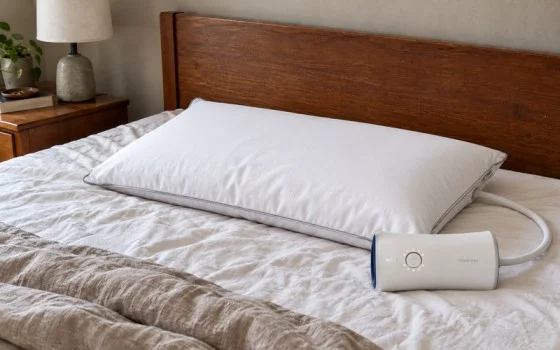
Nitetronic Z6 Smart Anti-Snore Pillow
4.6 (131 reviews)
|
Fill |
Memory foam core with 6 airbags inside |
|
Cover Material |
100% Cotton |
|
Firmness |
Firm |
|
Loft |
Adjustable |
|
Trial Period |
30 Nights |
|
Warranty |
3 years |
The Nitetronic Z6 is the only pick here that reacts to snoring while it happens. Its sensors listen for snoring and track where your head is. When they hear snoring, six airbags inside the pillow fill with air and turn your head to the side. It is a type of positional therapy. It does the same job as the old tennis ball trick, where you sew a ball into the back of your shirt. The only difference is that the pillow does the job while you’re sleeping.
Experience
Sarah spent the first 5 nights setting up the app and choosing a sensitivity level; she settled on level 3. After that, the Z6 worked the same way every night for the full 2 months. Each time its sound sensors picked up snoring, the airbags rolled her head to the side with no jolt. It never awoke her once. Her SnoreLab score went down from 48 on her old pillow to 12 and remained at 12. The control unit takes up space on the nightstand. However, Sarah says that it is the most effective smart fix she has used for back snoring after 2 months.
Best For
Back sleepers with position-dependent snoring (they snore on their back but not on their side), and partners who want the pillow to do the nudging. It’s also great for those who enjoy sleep data.
Not Ideal For
Anyone under 18 or with sleep apnea, a pacemaker or a head implant.
Pros
- Only acts when you snore
- Never woke our tester in 2 months
- Adjustable sensitivity and height
Cons
- Costs $549 on sale (Oct 2026)
- Takes 5 to 7 nights to tune
- 3% fee on change-of-mind returns
MedCline Shoulder Relief System: Best Wedge Pillow for Snoring
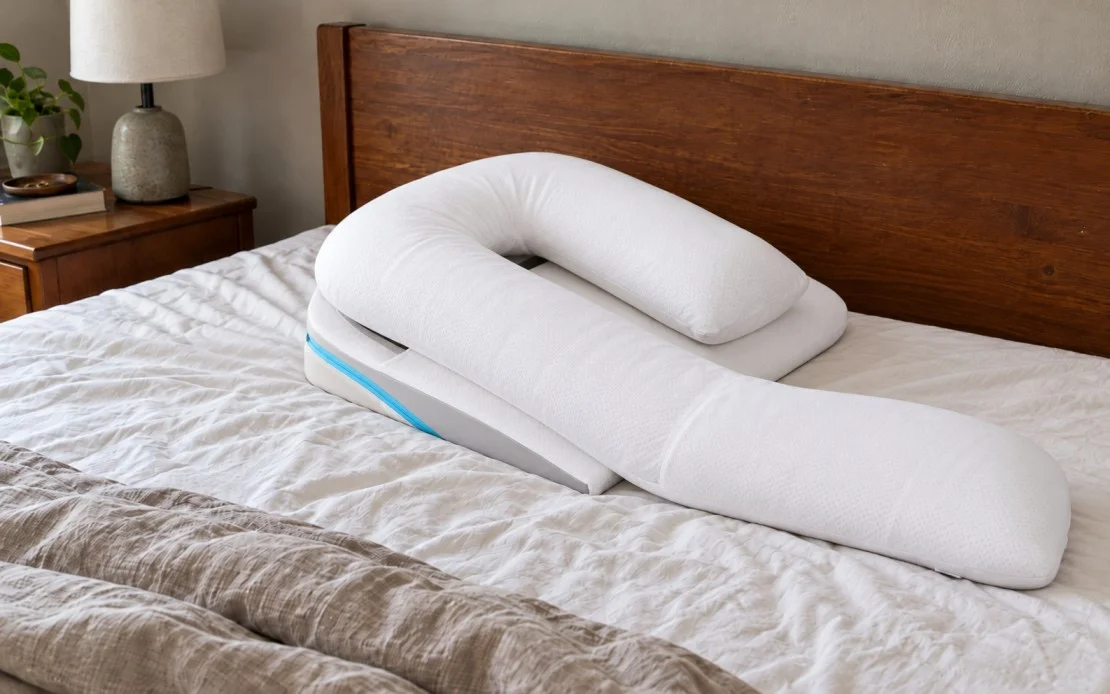
MedCline Shoulder Relief System
4.2 (2,529 reviews)
|
Fill |
Multiple polyurethane foam layers |
|
Cover Material |
80% cotton / 20% polyester blend |
|
Firmness |
Medium-Firm |
|
Loft |
6 in tall |
|
Trial Period |
30 days |
|
Warranty |
1 year |
The MedCline system is one of the best wedge pillows for snoring, as it performs two functions. Its 6-inch wedge raises your upper body at a 10° slope. A patented arm pocket and a body pillow hold you on your side, so you don’t slide onto your back. MedCline sells it for shoulder pain, but its label also talks about snoring. The label tells you to see a doctor if you snore and feel sleepy in the day, or if your partner notices that you stop breathing.
Experience
Zaidan took 4 nights to get used to the 10° slope and the arm pocket. He had no pressure on the shoulder under him, and no numbness in his hand with his lower arm in the pocket. The body pillow held him on his side all night and stopped him from rolling onto his back. His SnoreLab score dropped from 52 to 14, and his wife reported that the snoring had stopped. The system takes up half the bed, but Zaidan thinks it’s worth the space for a side sleeper.
Best For
Side sleepers who roll onto their back during sleep, particularly if they also wake up with pain in their shoulder or a numb arm.
Not Ideal For
Full beds or smaller, and back sleepers who want to remain on their back. Avoid it if you have a back or hip injury, heart disease, or a lot of excess weight.
Pros
- Slope and side support in one
- Works on either side
- Access to sleep specialists
Cons
- Up to 30 nights to break in
- $25 fee and 30-day returns.
- No wedge-only option
Helix ComfortAdjust Cooling Pillow: Best Adjustable Pillow for Snoring
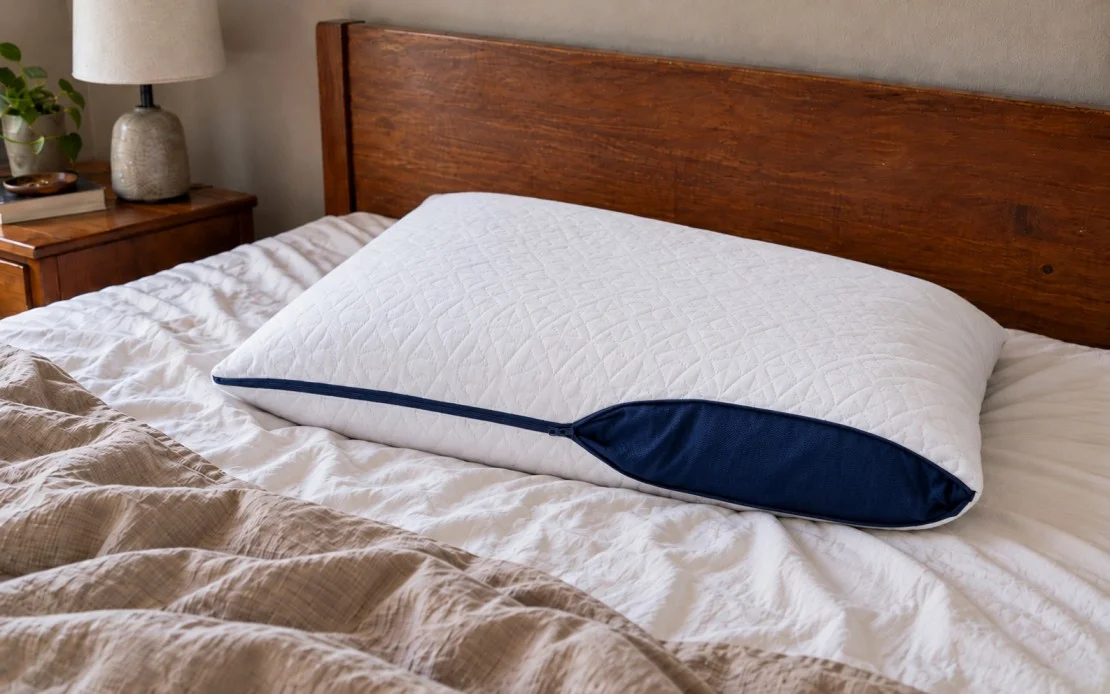
Helix ComfortAdjust Cooling Pillow
4.6 (124 reviews)
|
Fill |
Shredded memory foam and fiber blend |
|
Cover Material |
GlacioTex cooling cover |
|
Firmness |
Medium-Firm |
|
Loft |
Soft/Medium |
|
Trial Period |
30 nights |
|
Warranty |
1 year |
When your head is at a poor angle while sleeping, your pillow is likely too high or too low for your sleeping position. The Helix ComfortAdjust corrects this by allowing you to create your own height. It arrives overfilled. Remove shredded memory foam and fiber until the desired height is achieved. Then there are two zippers on the inside to adjust the firmness: zipped on both sides is firm, zipped on one side is medium, and zipped on neither side is soft.
Experience
The pillow arrived overfilled. Zaidan took out the shredded foam twice until it was full between his head and shoulder. He then set the zippered insert to medium-firm. On his side, his neck stayed in a straight line with his spine, and his chin didn’t tip toward his chest. His SnoreLab score went from 34 to 18. The GlacioTex cover felt cool through all 14 nights, which hot sleepers will like.
Best For
Combination and hot sleepers, plus back sleepers whose chin tips forward on thick pillows.
Not Ideal For
People who want a washable pillow, a set-and-forget fit or a long trial.
Pros
- Separate height and firmness controls
- Reusable extra fill
- Works in every position
Cons
- Spot-clean only
- Short 30-night trial
- No slope or position control
Snore Less Now Posiform Anti-Snore Pillow: Best Snoring Pillow for Side Sleepers
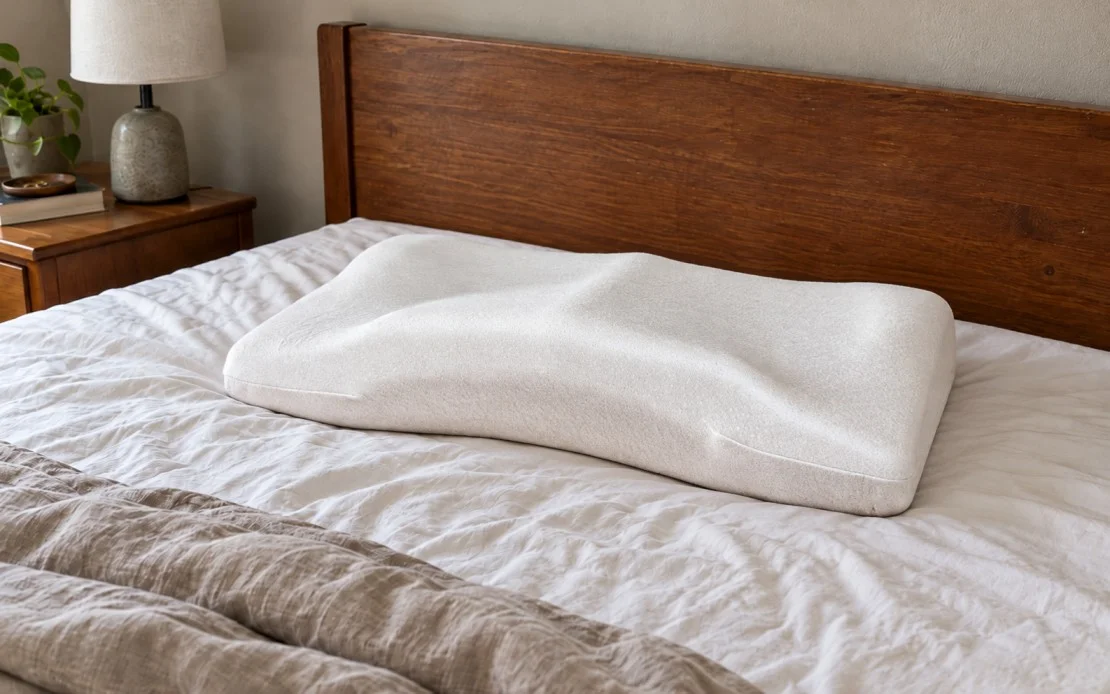
Snore Less Now Posiform Anti-Snore Pillow
4.8 (99 reviews)
|
Fill |
Memory foam core |
|
Cover Material |
100% Cotton |
|
Firmness |
Medium-Firm |
|
Loft |
Medium-High |
|
Trial Period |
120 nights |
|
Warranty |
3 years |
Many side sleepers start snoring when they drift onto their back. The Posiform’s job is to keep you on your side. It has a forehead rest and cutouts for your ear and shoulder. These make side sleeping comfortable and tilt your head slightly down. The shape also makes it difficult to roll onto your back. Snore Less Now points to a published study of 28 people with positional obstructive sleep apnea. This pillow was tested under its European name, Posiform.
Experience
The curved shape, forehead rest, and ear cutout made side sleeping feel natural. Zaidan needed 3 nights to get comfortable with the ear pocket. After that, a raised ridge in the pillow stopped him from rolling onto his back in his sleep. After he stopped sleeping on his back, his snoring stopped as well. His SnoreLab score fell from 41 to 8, the lowest score Zaidan recorded without CPAP.
Best For
Back snorers who want to learn to sleep on their side, and allergy sufferers who like washable covers.
Not Ideal For
Stomach and combination sleepers. Broad-shouldered sleepers should take note that the brand does not mention any height.
Already on your side and looking for comfort, not position control, our best pillow for side sleepers guide has you covered.
Pros
- Designed for positional snoring
- 120-night trial
- Two washable covers
Cons
- Height unknown before you buy
- Small brand-cited study
- No adjustment
Tuft & Needle Original Foam Pillow: Best Budget Pillow for Snoring
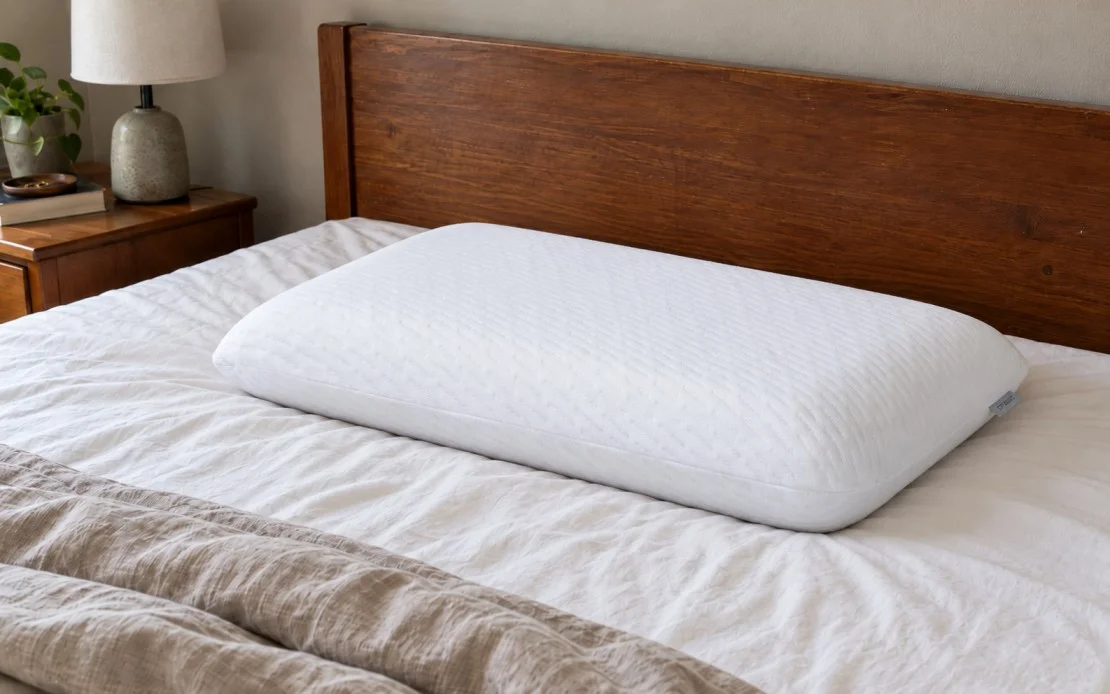
Tuft & Needle Original Foam Pillow
4.2 (2239 reviews)
|
Fill |
T&N Adaptive foam infused with graphite and cooling gel |
|
Cover Material |
Micro Polyamide & Polyester |
|
Firmness |
Medium-firm |
|
Loft |
5 in |
|
Trial Period |
100 nights |
|
Warranty |
3 year |
An old, flat pillow gives your head poor support, and a stack of pillows pushes your chin down, which can narrow your airway. The Tuft & Needle Original allows you to rule that out without the risk. It’s one slab of open-cell Adaptive foam with a steady 5-inch height. Tuft & Needle kept the Standard size listed on its site for $100 in October 2026, and offered a 100-night trial. While it is not the least expensive pillow on this guide, it is the least expensive everyday pillow that offers a long trial.
Experience
After 2 months of nightly use, the 5-inch Adaptive foam showed no sag or flat spot in the center. Sarah’s head was resting on a flat pillow, and her head was tilted back, making it difficult to breathe. This firm foam block maintained her head in a stable, neutral position and prevented her chin from dropping towards her chest. Her SnoreLab score went from 38 to 22. It was flat, but the foam would come back up every morning.
Best For
People who have an old pillow that has lost its shape and hot sleepers who want to try out better support before purchasing a more expensive pillow.
Not Ideal For
Broad-shouldered side sleepers, snorers who need a slope, and people who wish to wash the foam core.
Pros
- 100-night trial
- No sag after 2 months
- Cooling graphite and gel
Cons
- No adjustment
- No position control
- Only the cover goes in the wash
DaVinci Orthopedic Pillow: Best Snoring Pillow for Back Sleepers
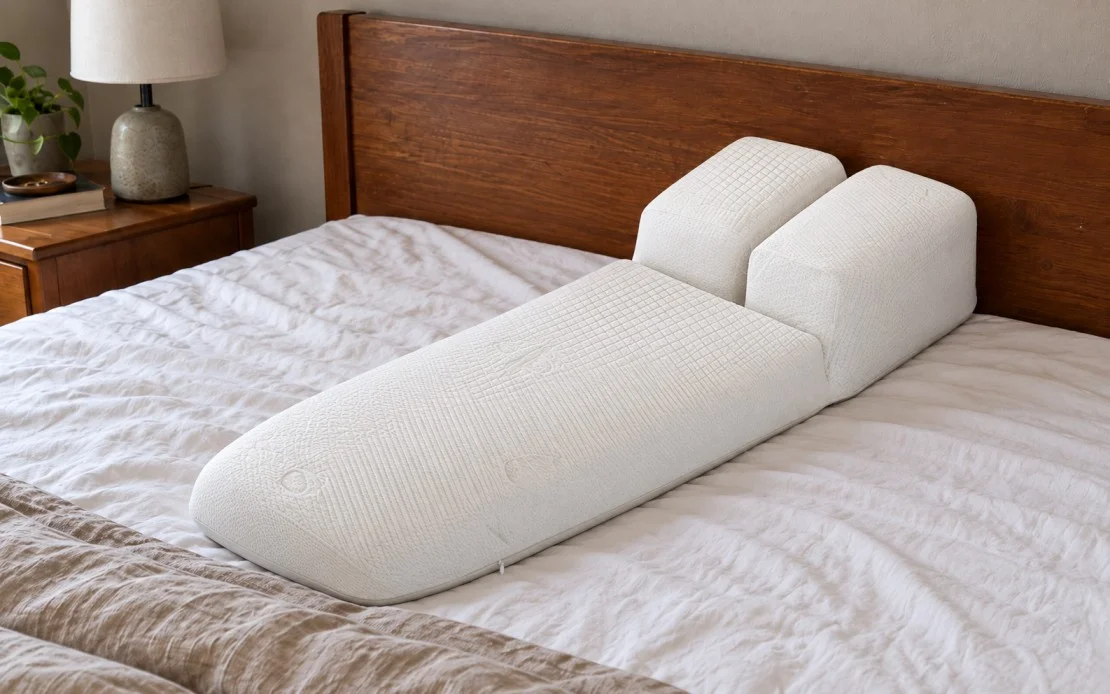
DaVinci Orthopedic Pillow
4.3 (10 reviews)
|
Fill |
Gel-infused memory foam |
|
Cover Material |
100% white polyester fabric |
|
Firmness |
firm |
|
Loft |
Adjustable |
|
Trial Period |
30 night |
|
Warranty |
30 days |
The DaVinci Orthopedic Pillow is one long piece, about 12 inches wide and 36 inches long. It supports your head, neck, and upper back together. This prevents a back sleeper from falling into a chin-down position. For snoring, DaVinci suggests you slide one or two pillows under the head end to make a 15–20° slope. DaVinci also says the pillow doesn’t replace CPAP, but you can use the two together. Ignore the big claims on DaVinci’s site about ending snoring or treating breathing problems. No pillow can make that promise, and we didn’t test for that.
Experience
Sarah followed DaVinci’s advice and put an extra pillow under the head end to make a 15° slope. Over 2 months, the 36-inch pillow kept her head, neck and upper back raised together, so her neck didn’t bend, and her posture stayed in line. It wasn’t just her head that was lifted. Her SnoreLab score went from 45 to 16 and remained stable.
Best For
Back sleepers who wish to remain on their back, and those who sleep on their back and side and require upper back support without the use of a bed wedge.
Not Ideal For
Stomach sleepers, shoppers who prefer a built-in slope, and anyone who might want to return it.
Pros
- Supports head to upper back
- Washable, replaceable cover
- Works with CPAP, per DaVinci
Cons
- No returns once opened
- Few published specs
- Overblown marketing claims
Therapeutica Sleeping Pillow: Best Pillow for Snoring and Neck Pain
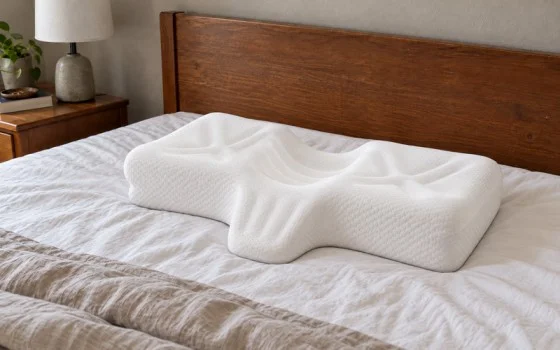
Therapeutica Sleeping Pillow
4.2 (2,854 reviews)
|
Fill |
Resilient molded polyurethane foam |
|
Cover Material |
Quilted polyester zip cover |
|
Firmness |
Firm |
|
Loft |
5.25 in |
|
Trial Period |
90 days |
|
Warranty |
5 years |
The Therapeutica is the best pillow for neck pain and snoring, as it does both with precision. Its molded foam has a center cradle and a neck curve for back sleeping. Side sleeping is supported with raised side panels and a wedge section under your upper back. The size is determined by measuring from the base of the neck to the end of the shoulder. The correct size will ensure that your head is not tilted. Core Products says a level head may reduce snoring.
Experience
Zaidan measured from his neck to his shoulder with Core Products’ size guide and chose the Average size. For the first 5 nights, the molded foam felt hard and stiff. Then the raised side panels delivered his shoulder with the correct lift. He had no neck pain upon waking, his spine remained straight, and his SnoreLab score dropped from 36 to 11.
Best For
Back and side sleepers who snore and wake up with a stiff neck, and those who prefer firm support.
Not Ideal For
Stomach sleepers and those who desire comfort from night one. If you have a soft mattress, size down or skip it.
For those who have neck pain as their primary concern and snoring as a secondary concern, our list of pillows for neck pain includes more contour and memory foam options.
Pros
- 5-year warranty
- 3 sizes and 2 firmness levels
- Upper back wedge
Cons
- Up to 2 weeks to adjust
- Fixed height for each size
- 5–7 days to expand after shipping
Contour Products CPAPMax 2.0 Pillow: Best CPAP Compatible Pillow
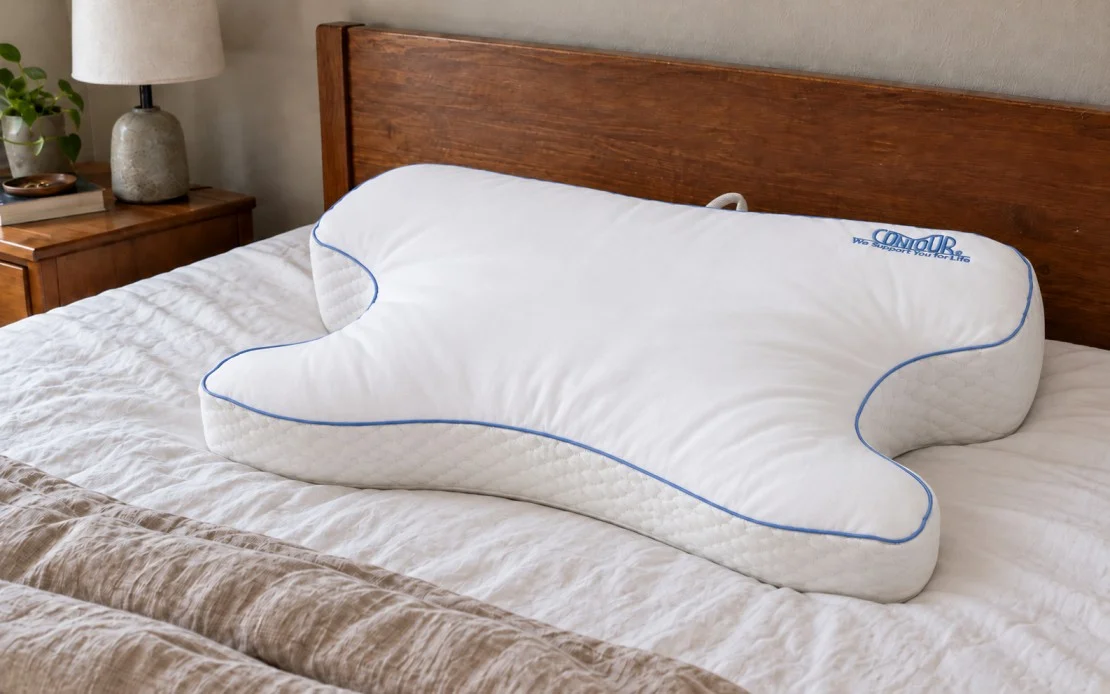
Contour Products CPAPMax 2.0 Pillow
4.4 (181 reviews)
|
Fill |
Ventilated memory foam |
|
Cover Material |
Quilted, Mesh/Fiber Fill |
|
Firmness |
Firm |
|
Loft |
Adjustable |
|
Trial Period |
45 night |
|
Warranty |
1 year |
Your pillow has a new role if you’ve been diagnosed with sleep apnea and use CPAP. You no longer have to move position. It needs to keep your mask in place. The Contour CPAPMax 2.0 has mask cutouts on both sides, a strap (tether) that stops the hose from tugging, and four heights from 2 to 5 inches. Contour says it works with nasal, full-face and nasal pillow masks.
Experience
Zaidan tested the pillow on his side with his full-face CPAP mask. The wide side cutouts kept the pillow from pushing on the mask, so the seal never shifted and he heard no air-leak noise. The hose tether stopped the tube from pulling during the night, and the removable layers made it easy to set the height. CPAP felt comfortable to use every night, and his SnoreLab score stayed at 5 for the whole test.
Best For
Side and stomach sleepers who struggle to keep a mask in place throughout the night while using CPAP.
Not Ideal For
Snorers who don’t use CPAP, side sleepers who need more than 5 inches of height, and anyone who wants a standard pillowcase.
Pros
- Mask cutouts on both sides
- Hose tether
- 4 height settings
Cons
- Small size
- Pillowcase costs extra
- No anti-snore feature
Sweet Zzz Plant-Based Pillow: Best Snoring Pillow for Pressure Relief
Sweet Zzz Plant-Based Pillow
4.6 (882 reviews)
|
Fill |
100% soybean-fiber plant-based down |
|
Cover Material |
100% natural cotton |
|
Firmness |
Firm |
|
Loft |
Low |
|
Trial Period |
50 days |
|
Warranty |
1 year |
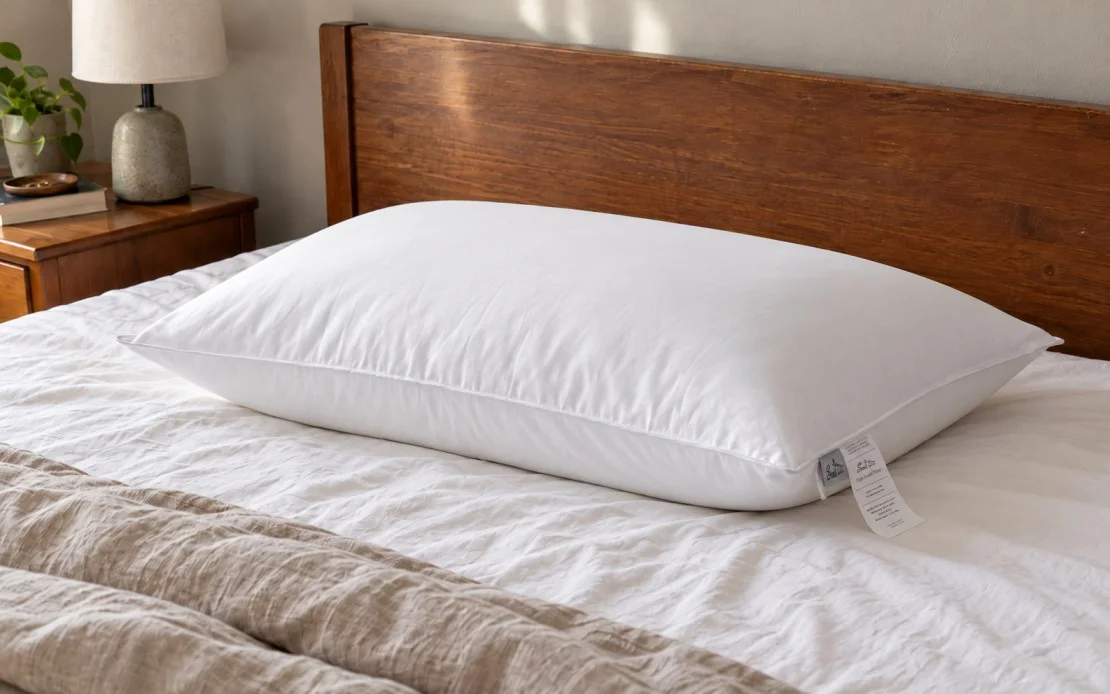
The Sweet Zzz Plant-Based Pillow features a soft exterior and a firm interior. Plant-based down from soybean fiber is used for both layers. Your head sinks a little but doesn’t hit the bottom. Two things are more important to snorers than softness. First, you choose a 5” (low) or 7” (high) height to match your sleeping position. Second, the entire pillow can be machine washed, which is beneficial if allergies and a stuffy nose contribute to your snoring.
Experience
The 7-inch tall version was tested by Zaidan for side sleeping. The firm soybean-fiber core held up his head, and the plant-based outer layer felt soft against his ear. He washed and dried the entire pillow in the washing machine to help clear dust allergens and a blocked nose, which can contribute to snoring. It came out with the same shape and height. He continued to breathe normally, and his SnoreLab score dropped from 29 to 15.
Best For
Snorers with allergies who wish to wash the entire pillow, and those who dislike feathers and polyester. Choose 7” for side sleepers or 5” for back sleepers.
Not Ideal For
Combination sleepers, snorers who need a slope and fans of firm neck support.
Pros
- Fully machine washable
- Two heights
- Public OEKO-TEX certificate
Cons
- No adjustment
- No snoring-specific design
- Only a 1-year warranty
Snorinator Pillow: Best Incline Pillow for Snoring
Snorinator Pillow
2.5 (76 reviews)
|
Fill |
CertiPUR-US® Certified Memory Foam |
|
Cover Material |
super soft, machine washable |
|
Loft |
5.6 inch |
|
Trial Period |
30 days |
|
Warranty |
No |
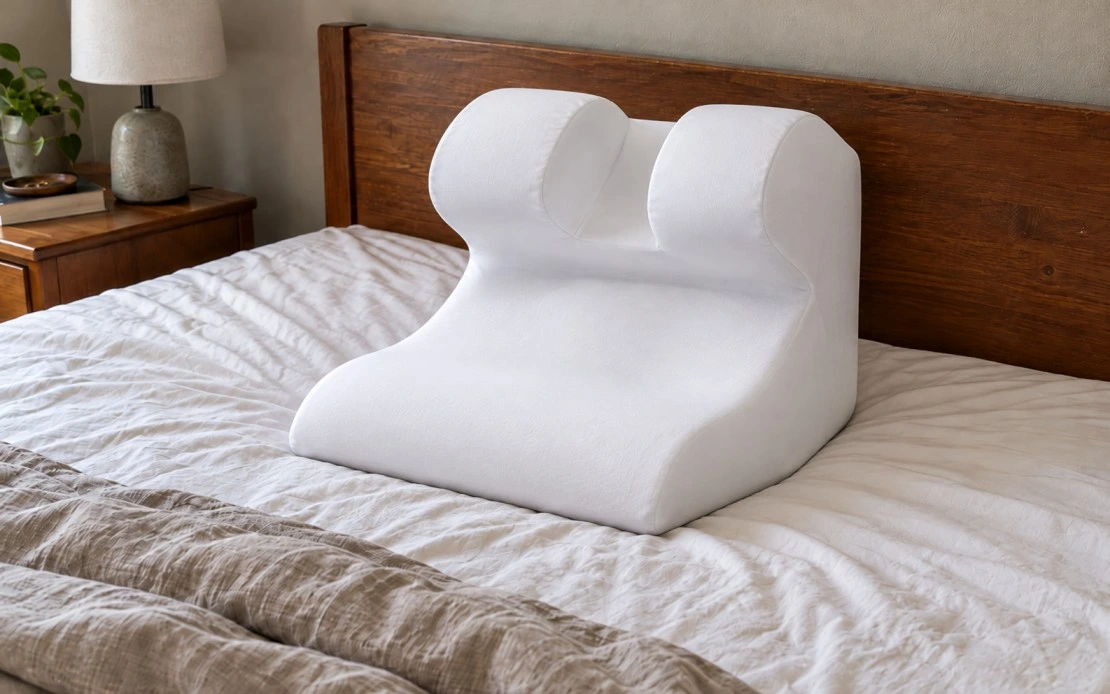
The Snorinator is a high-density memory foam backrest. It sits against your headboard and props you almost upright, at a 66° angle. That’s a lot more than the MedCline wedge’s 10° and is perfect for those who already sleep better in a recliner. Choose a size based on height: Small (5’6″ and below) and Large (taller).
Experience
It was different for the first few nights sleeping propped up at 66°. During the 2-month trial, however, it was most beneficial for Sarah’s loud snoring. The thick memory foam base and backrest prevented her from rolling down the bed while sleeping. Sitting upright, gravity will not pull the tissue in her throat back. Her SnoreLab score dropped from the highest baseline score in our test (58) to 4, and the app recorded no heavy snoring.
Best For
Support back sleepers who experience less snoring when sitting up, such as those who already sleep in a recliner or read in bed.
Not Ideal For
Side and stomach sleepers, people who can’t sleep upright, and anyone who may want to return it.
Pros
- Steepest slope here
- No electronics or setup
- Washable case included
Cons
- No returns once opened
- Big change from flat sleeping
- Few published specs
How to Choose the Best Pillows for Snoring
Follow these five steps to choose a pillow for snoring:
- Find out when you snore. Have your partner ask you or use a snore app to record a few nights.
- Match pillow type with your snoring. Choose a position pillow, a slope, or a neck-support pillow to suit the observation.
- Select the proper sleeping position. Side sleepers require the most height; stomach sleepers require the least.
- Cleaning and cooling check. If allergies or heat are a factor, choose a cooling or washable pillow.
- Test for 2 weeks. Before and after snore scores, and hang on to the box until you make your decision.
Which Type of Anti-Snoring Pillow Do You Need?
|
What you notice |
What kind of pillow helps |
Picks to consider |
|---|---|---|
|
You snore loudly on your back but quietly on your side |
A pillow that turns you or keeps you on your side |
Nitetronic Z6, Posiform |
|
You snore whenever you lie flat |
A slope that raises your upper body |
MedCline, DaVinci (with extra pillows), Snorinator |
|
You wake with a stiff neck, your chin down or your head tipped |
The right height and a neck curve |
Therapeutica, Helix ComfortAdjust |
|
You have a stuffy nose at night or dust allergies |
Washable materials that hold fewer allergens |
Sweet Zzz, Posiform (washable covers) |
|
You already use CPAP |
A mask-friendly design |
Contour CPAPMax 2.0 |
|
Your partner hears you gasp, choke or stop breathing |
See a doctor before you buy a pillow |
None |
How High Should a Pillow for Snoring Be?
The best pillow height for snoring keeps your head in line with your spine, so your neck doesn’t bend up or sag down. Side sleepers need the greatest height due to the larger space created by their shoulders. Medium height is best for back sleepers, and the least height is best for stomach sleepers.
Loft is the height of the pillow. Our pillow loft guide gives height ranges, and our pillow height calculator estimates yours.
Firmness determines if that height is maintained throughout the night. If a soft pillow collapses by an inch, the correct height becomes the incorrect height. See firm vs soft pillows to learn how each feel works in each position.
Size matters too. Before purchasing pillowcases, verify the pillow size. The CPAPMax 2.0 measures 20 x 13 inches, so it’s smaller than a standard 20 x 26 pillow.
Raise Your Whole Upper Body, Not Just Your Head
A stack of pillows will bend your neck forward and bring your chin toward your chest. That can constrict your airway instead of opening it. A wedge or upright support raises your chest and shoulders with your head, maintaining the same angle. One small home study of 25 snorers found that sleeping on a bed tilted 12° reduced the amount of time spent snoring by 7% compared to sleeping flat (JMIR Formative Research, 2022). The picks here span a broad spectrum, from MedCline’s 10° to DaVinci’s 15–20° (with pillows under) to the Snorinator’s 66°. Use the flattest slope possible to sleep on. Doctors also suggest raising the head of the bed for acid reflux at night (American College of Gastroenterology).
Check Your Mattress Before You Blame the Pillow
A soft mattress or a very soft mattress allows your shoulders and hips to sink. That alters your head position. A good pillow on a hard mattress may cause the head to be elevated too much on a soft mattress. That’s why Core Products tells people with soft mattresses to choose one Therapeutica size smaller.
How Does a Smart Anti-Snore Pillow Work?
A smart anti-snore pillow will detect snoring and move your head accordingly. The Nitetronic Z6 uses sensors to hear snoring and six airbags to turn your head to the side. It is a positional therapy, and it will only be helpful if your snoring is position-dependent.
The Z6 requires a control unit near your bed, an application to receive sleep reports and settings, and 5-7 nights of tuning. It also comes with medical limits that normal pillows don’t have (see its review above). Before purchasing, decide on the location of the control unit.
Rule Out Sleep Apnea Before You Shop
If you’re looking for the best pillows for sleep apnea and snoring, start with a doctor, not a pillow. If you snore loudly and gasp, choke, or stop breathing while sleeping, or wake up with headaches or daytime tiredness, see a doctor before purchasing anything. Mayo Clinic lists all of these as possible signs of obstructive sleep apnea. If you are already using CPAP, select a pillow that will safeguard the seal of your mask. That’s the CPAPMax 2.0’s job.
Which Snoring Pillows Can You Wash?
Only the Sweet Zzz goes in the washing machine whole. Most other pillows here let you wash just the cover, and you can only spot-clean the Helix ComfortAdjust. This matters because allergens that build up in a pillow can make a stuffy nose and your snoring worse.
See how to wash pillows for care tips by fill type. Hot sleepers should look for cooling covers (Helix), gel and graphite in the foam (Tuft & Needle), or natural fibers (Sweet Zzz). Our guide to sweating on your pillow at night covers other causes of night sweats.
How to Test a Snoring Pillow at Home
You can check whether a snoring pillow works with a small version of our test:
- Record three nights on your old pillow with a snore-tracking app such as SnoreLab.
- Use the new pillow and allow yourself one week to get used to it.
- Check your scores against your baseline and request notes from your partner as well.
- Hold onto the box until you’re sure, as some brands require the box to be returned.
Please read the return rules before opening anything. The Snorinator and the DaVinci (if you buy direct) take no returns after you open them. MedCline makes you use its system for 30 days before you can return it, and it charges a $25 fee. Nitetronic charges return shipping plus 3% if you change your mind. Posiform’s 120 nights, Tuft & Needle’s 100 nights and Therapeutica’s 90 days give you the most time.
When a Pillow Isn’t Enough
Snoring is common. About 45 percent of adults snore sometimes, and 25 percent snore regularly, says the American Academy of Otolaryngology–Head and Neck Surgery. A pillow changes your position and alignment. Alcohol close to bedtime, extra weight, and a stuffy nose can all keep you snoring, whatever pillow you use. Mayo Clinic suggests no alcohol for at least two hours before bed. For fixes beyond your pillow, such as nasal strips, mouthpieces, and lifestyle changes, see our guide on how to stop snoring.
Final Verdict
If you snore mostly on your back, choose the Nitetronic Z6. If you snore whenever you lie flat, choose the MedCline to stay on your side or the Snorinator to sleep propped up. For side sleepers, you should try Posiform. When you can’t get a good night’s sleep with your current pillow, try the Tuft & Needle Original. If neck pain comes with your snoring, choose the Therapeutica, and if you use CPAP, choose the CPAPMax 2.0. If the height you need changes from night to night, choose the Helix ComfortAdjust.
Frequently Asked Questions
Snoring pillows are effective if your snoring is related to position or head angle, but not for all snorers. Pillows that turn your head, support you on your side, or elevate your upper body tackle snoring straight on. If you snore just as loudly on your side or you stop breathing at night, a pillow won’t solve the problem.
The best type of pillow depends on when you snore. If you snore only on your back, a position pillow like the Nitetronic Z6 or Posiform works best. If you snore at all times when you lie flat, a slope helps. If you wake up with a stiff neck, opt for a neck-support or adjustable pillow that keeps your chin away from your chest.
A pillow will not cure OSA, but it can support your treatment. If you use CPAP, a mask-friendly pillow like the CPAPMax 2.0 helps keep your mask in place. Doctors sometimes use positional therapy, which keeps you off your back, for positional apnea. However, Nitetronic states that the Z6 is not for people with obstructive sleep apnea syndrome.
Wait at least two weeks to evaluate a snoring pillow. First, spend 3 nights on your old pillow. After you have adjusted, compare your second week on the new one. Always read the return policy before buying. Some brands require you to wait 30 days to return a pillow, and some brands do not accept returns after opening.
Yes, you can still snore on your side. Side sleeping reduces snoring for many people, but not for everyone. A stuffy nose, the wrong pillow height for your shoulder width, alcohol and extra weight can all keep you snoring. Adjust your pillow height and if the snoring persists, consult a doctor.
Source
We checked every product spec, price, trial and warranty on the brand’s own pages in October 2026. Health facts come from the medical sources below.
Medical and research sources
- American Academy of Otolaryngology–Head and Neck Surgery: What Are Snoring and Sleep Apnea?
- Mayo Clinic: Snoring, diagnosis and treatment
- Mayo Clinic: Obstructive sleep apnea, symptoms and causes
- Walsh JH et al. Influence of head extension, flexion, and rotation on collapsibility of the passive upper airway. Sleep, 2008.
- Danoff-Burg S et al. Sleeping in an inclined position to reduce snoring and improve sleep. JMIR Formative Research, 2022.
- Srijithesh PR et al. Positional therapy for obstructive sleep apnoea. Cochrane Database of Systematic Reviews, 2019.
- Katz PO et al. ACG Clinical Guideline: Guidelines for the Diagnosis and Management of Gastroesophageal Reflux Disease. American Journal of Gastroenterology, 2022.
- Newell J, Mairesse O, Neu D. Can positional therapy be simple, effective and well tolerated all together? Sleep and Breathing, 2018.
- SnoreLab: How SnoreLab works