Firm vs. Soft Pillow: Which One Is Better for Your Sleep?
You spend about one-third of your life with your head on a pillow. But most people opt for the wrong level of firmness, ending up with sore necks and interrupted sleep. There is a clear answer to the firm vs soft pillow debate, which depends on your sleeping position, body type, and pillow material.
Here’s the short version. Side sleepers will typically require a firm pillow. Soft is best for stomach sleepers. Back sleepers are in between. Back sleepers fall somewhere in between. However, firmness isn’t the only thing that will help you sleep — loft, fill, and your mattress all have a role to play.
One thing is consistent with all the pillows we’ve tested: the “comfiest” pillow in the shop is seldom the one that will keep your spine in line by morning. This guide will help you understand what firmness is best for you, why it’s important, and how to avoid the most common pitfalls. For our complete list of pillows we’ve tested, start with our list of the best pillows.
Firm vs. Soft Pillow: What’s the Difference?
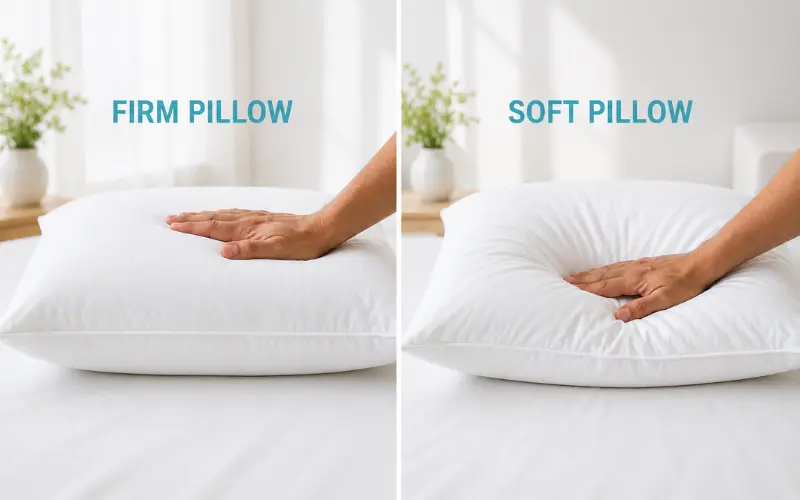
A firm pillow will not give in to pressure and will maintain its shape, which will keep your head up and stable. A soft pillow is easy to compress and allows your head to sink into it for a cushioned, soft feel. This one difference—how much the pillow gives—affects all else about your sleep.
Consider firmness to be resistance. Push a firm pillow back and forth with your hand. When you press on a soft one, you can easily make your hand sink. This is why side sleepers lean firm and stomach sleepers lean soft – each position requires a different level of support.
In short: Firm pillows are all about support and stability. Soft pillows are all about comfort and contouring. There is no better or worse — it depends on your sleeping style.
Pillow Firmness
Manufacturers measure the firmness of the pillows on a firmness scale of 1 to 10, with 1 being extremely soft and 10 being extra firm. The majority of pillows range from 3 to 7. A medium-firm pillow (a rating of 5 or 6) is ideal for most sleepers.
People often mix up firmness and loft: they are not the same. Firmness refers to the amount of pressure the pillow can resist. When you lie down, it reaches its height, which you call loft. A pillow can be thick and fluffy, or thin and firm.
Experts typically divide loft into three categories: low loft (less than 3 inches), medium loft (3 to 5 inches), and high loft (more than 5 inches). Loft refers to the height of your head when you’re sleeping — we have a detailed pillow loft guide. Firmness regulates the stability of that height, which it maintains through the night.
The bottom line: always look at both numbers before purchasing. Even a firm pillow that is not the right loft will cause your neck to bend out of alignment.
How Pillow Material Affects Firmness
The material you use to stuff your pillow determines its feel, longevity, and coolness. Two pillows may be of the same loft, but feel entirely different due to the material. Below is a comparison of the common fills.
Memory foam fill conforms to the shape of your head and neck and gradually springs back into place. It provides good support but does not allow heat to escape, so seek ventilated or gel types. Some brands incorporate graphite technology to take heat from the top.
Down fill and down alternative fill are soft and compressible, making them ideal for soft pillows. The downside is that they will flatten more quickly and you must fluff them regularly. The cheap choice is polyester fill (fiberfill), which is soft when new, but will lose loft in 6 to 12 months.
Latex and buckwheat are on the harder end. Latex blend pillows are breathable, bouncy, and can last for 7 to 10 years. Buckwheat fill is firm, naturally cool and lasts up to 10 years with refills.
Firm Pillows: Pros, Cons, and Best For
Firm pillows are designed to provide support and maintain their form over time.
Pros
- Firm support keeps your head level and your spine in line, perfect for side and back sleepers.
- Last longer than soft pillows and sag less; they need replacing less often.
- Sleep in cooler temperatures, because a firm surface will not wrap around the head as well and will hold heat in less.
- If you have allergies, dust mites are not an issue in denser fills.
Cons
- Less pressure relief, so they may feel firm to start with if they are accustomed to relaxing.
- Too hard and you can throw your head out of alignment, and your neck can become stiff.
- Not ideal for stomach sleepers as it increases the back bend of the neck.
Best For: Side sleepers, back sleepers, broad-shouldered, hot sleepers, and allergy sufferers.
When a Soft Pillow Is the Better Pick
Stomach sleepers should sleep on a soft pillow. The aim of this goal is reversed. The head should be as low and flat as possible, not raised.
You already have your neck turned to one side when you sleep on your stomach. Place a sturdy, high pillow over this, and your head will tilt back, further straining the neck. A thin, soft pillow helps to maintain that angle.
Only about 7% of adults sleep on their stomach, and sleep specialists tend to single it out as the hardest position on the body. It pulls the spine out of alignment, the Cleveland Clinic notes.
Pro Tip: If you sleep on your stomach, use a 3-inch-thick pillow or no head pillow at all. A flat pillow under your hips takes some of the strain off your lower back.
For those who prefer a plush, sink-in feel or those who move around during the night, soft pillows are also suitable. The disadvantage is that they lose their shape quickly and require fluffing to keep them level. We tested one soft, plush pillow, and it started to flatten after a year.
If you sleep on your stomach, our top recommendations for the best pillow for stomach sleepers are low, soft pillows that don’t overwork the neck. It’s not surprising that height is mentioned as frequently as firmness.
Soft Pillows: Pros, Cons, and Best For
Soft pillows give up support in favor of cushioning. It depends on your sleeping style whether that helps or not.
Pros
- Pillows pressure points and cradle your head for a plush, sink-in feel.
- Mold to you and adjust when you move, which helps combination sleepers.
- Easy to fold or shape under the head, light.
- Maintain the low and flat head position that gentle-angle stomach sleepers require.
Cons
- Too little support for most side and back sleepers, so the head can sink out of line.
- Spend more time replacing them because they become flatter and lose shape quickly.
- Tend to trap more dust and allergens as they age.
Best for: Stomach sleepers, combination sleepers, smaller frames, and anyone sleeping on a firm mattress who wants to fill the space.
What About Medium-Firm Pillows?
Medium firm pillows are in the middle and, for many people, are the safest choice. They combine the support of a firm pillow with a bit of the give of a soft pillow.
This makes them a good choice for back sleepers and combination sleepers. Back sleepers will receive sufficient support for the angle of the neck, with not too much lift. Combination sleepers have a feel that lasts through the transitions between sleep positions.
They are also ideal for individuals who are not sure of what firmness they want, or those who have a partner who prefers a different level of firmness. You receive constant support without the hard, propped-up feel that some firm pillows have.
As we have found, the medium-firm pillow is the one we would give to someone who doesn’t know where to put their head. It resolves the most frequent complaints while not being too extreme on either side. A medium-firm pillow with a removable fill allows you to adjust the firmness of the pillow over time.
Why Height Matters
Loft, or pillow height, is as crucial as firmness, and many more people get it wrong. The ideal firmness of a pillow can make it just as painful if it is placed too high or too low.
The loft is the height of the pillow when your head is placed on it. Most side sleepers require about 4 to 6 inches of space to fit in the shoulder gap. 3 to 5 inches is ideal for back sleepers, while stomach sleepers prefer less than 3 inches.
Firmness is linked to height. The pillow’s firmness is what determines if it will retain its height throughout the night or sink when you sleep. A soft pillow could be 5 inches thick when you go to bed and only 2 inches thick by morning, when you’re on your side.
We had this with a tall, fluffy pillow that felt wonderful at first, then compressed into a flat pillow after a few hours. The test for it is simple. While lying on your side, aim to position your ear, shoulder, and neck in a straight line. Our pillow loft guide explains it all in terms of heights by position and body size. All this is shaped by what is inside the pillow.
How the Fill Changes the Feel
The fill determines the level of firmness that a pillow will offer before you even lie down. Medium can mean two things on the same pillow if it’s filled with different stuff.
Memory foam fits your head and is available in soft, medium, and firm. It retains its form and is also allergen-resistant, making it a good option for people who sleep on their sides.
Latex sets around medium-firm. It is springy, breathable, and naturally repels dust mites, making it ideal for those who suffer from allergies or sleep hot.
Soft and moldable pillows are the classics. They are soft, but they collapse more quickly than foam and are a potential allergy trigger for some sleepers.
Buckwheat husks are some of the strongest pillows available. They are heavy, long-lasting, and can be poured in or out to adjust, but can be a bit firm and have a bit of a shifting sensation.
In the middle, there are shredded foam and other adjustable fills. The stuffing can be added or removed to make it firm or soft, depending on your preference, or if you share a bed with someone who prefers a different firmness.
Pay attention to the fill, not the firmness number. It provides much more information about the durability of the pillow.
Firm vs. Soft Pillow for Neck & Shoulder Pain
One of the most common causes of neck and shoulder pain in the morning is the firmness of the pillow. If your head is up or down, your neck will be at an angle for hours, and you will notice it when it’s dawn.

Adjust the firmness according to your position, and most of the strain is gone. A firm pillow that maintains the head level for the side sleeper relieves the pressure on the neck and shoulders. A Stomach Sleeper pillow is designed to prevent a stomach sleeper’s neck from turning over too much with a soft, low pillow.
It’s a bit too hard, and it is a problem. An elevated head position on a pillow raises the height of the chin toward the chest and compresses the neck. The objective is neutral: the ears, shoulder, and neck are aligned.
But a pillow can’t relieve pain that begins elsewhere; that’s not its job. If it persists for weeks, consult a doctor. If your pain is linked to your pillow, our pillow for neck pain guide matches firmness and height to problem areas.
How to Choose the Right Pillow Firmness for You
Begin with sleep position and then make adjustments for three things that can alter the answer.
You can’t be too lightweight on your mattress. A firm mattress will keep your body on top of the mattress so that a soft pillow can fill in the space nicely here. A soft mattress allows you to sink in, and typically requires a firmer pillow to keep your head level.
Your body size is also a factor. The broader the shoulders, the more height and support will be required to finish the horizontal span, and a smaller-sized frame will require less in the way of height and support to remain properly aligned on a soft, low pillow.
Personal feel is the last piece. Comfort has an impact on sleep, and some people don’t like the propped-up feel of a firm pillow. Quick test: Lie down in the same position you would sleep in, and ask someone to observe your neck. The head should be level, neither drooping nor lifted.
How to Spot a Pillow That’s Working Against You
You don’t need any special tools to check your pillow, just a mirror or someone to look for you. Lie down in the same position as you normally lie down and inspect your neck.
Your head should be level, not up or down. If your chin is resting on your chest, the pillow is too high. If the head tilts back, it’s too low. A good pillow is only as good as its use. The Sleep Foundation recommends changing pillows every 1-2 years. Memory foam and latex can last for 3 years or longer, while down and synthetic fillings will wear out earlier.
Hygiene is also a factor. After 2 years, a pillow can contain up to 2 million dust mites, and it gradually loses its ability to support the neck. Look for lumps, yellow stains, and a lack of fluffiness. A quick test is to fold the pillow in half – if it does not open up, replace it. One of the most cost-effective remedies for poor sleep is a new pillow, and it’s the most delayed.
Final Thoughts
The firm or soft choice is not the softest in the store, but rather the one you sleep best on. Firm pillows with medium to high loft are a good choice for side and back sleepers.
For stomach sleepers, the low and soft position is recommended to maintain a flat neck. When you’re moving around at night, or you don’t know, try a medium-firm, adjustable pillow. It can change its firmness in more positions than any fixed firmness.
We’ve tried a ton of pillows and believe that many people sleep on the wrong firmness and attribute it to the mattress. Swapping the pillow is quicker and a lot cheaper.
So, tonight, when you lie down, look at your neck in the mirror. If your head isn’t level with your spine, there’s your answer.
FAQ
A medium-to-medium-firm pillow is ideal for most people with neck pain. It maintains a neutral position of your cervical spine without sinking or elevating your head too high. Side sleepers may require a firmer mattress, and stomach sleepers should use a soft, thin one to prevent neck strain.
Firm, high-loft pillows are best for side sleepers. Lying on your side, there is a 4 to 6-inch space between your head and the mattress. A solid pillow fills that space, supports your neck and spine, and eliminates pressure on your shoulders throughout the night.
Firmness is the resistance of a pillow to pressure, while loft is the height of the pillow when lying on it. They are independent – a pillow can be tall and soft, or thin and firm. Both are important – loft determines head height, firmness ensures head height remains stable all night.