
Pillow Loft Explained: What It Is and How to Choose the Right Height
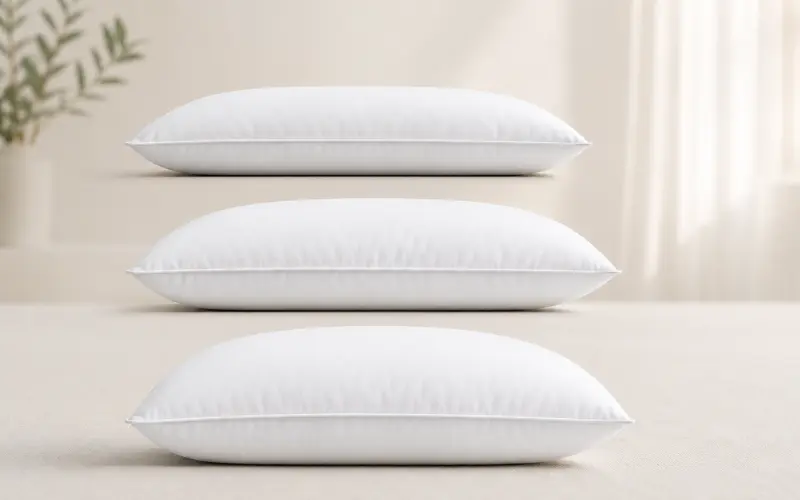
Quick answer: Pillow loft is the height of your pillow under your head. Side sleepers should look for a high loft (4-6 inches). We recommend a medium loft, 3-5 inches, for back sleepers. Stomach sleepers prefer a low loft under 3 inches. The right loft keeps the neck above spine level to wake up pain-free.
Most consumers choose their pillows based on softness. They do NOT measure the height. However, pillow loft will affect neck position throughout the night. Get it wrong, and you get up stiff and sore. Over half of adults suffer neck pain during any 6 months. Often, this is due to the improper pillow, which is a simple problem.
Pillow loft is made simple. You will discover the proper elevation for your sleeping position, body, and mattress. You will also be able to measure your own loft at home. If you’re going shopping, begin by taking a look at our list of the best pillows, and then narrow down your choice with this guide.
What Is Pillow Loft?
Pillow loft is the height of a pillow when lying down. To sum up, it is the amount of elevation the pillow provides your head above the mattress. That single measurement is what determines whether or not your neck stays straight or bends.
Typically, the height of pillows is 2 to 7 inches. You’ll also hear the term loft used in text: low loft, medium loft, and high loft. Some brands provide super-low loft for flat-pillow fans. Some people prefer to have a higher loft to suit their broad-shouldered side sleepers.
People know loft under various names. They may display the words pillow height, pillow profile or fill height. These all have the same meaning. However, don’t confuse loft with pillows. There are sizes such as standard, queen or king which is the surface area. Loft is not alone the elevation.
Static Loft vs. Effective Loft
The height of a pillow on the shelf differs from its height under your head. This can trick most shoppers. Two numbers are important here.
Static loft is the loft measured on a flat pillow with a ruler. Effective loft is the loft available after your head is compressed. Your weight compresses the fill, causing the pillow to become shorter.
Let’s look at an example of this. A soft down pillow might be 6” when it is in the store. It could compress down to 3 inches beneath your head. A firm latex pillow has minimal movement. Evaluate a pillow by the pillow’s loft, not the shelf number. This gap will make more buyers fall than any of the specifications mentioned on the label.
Loft vs. Firmness
Loft and firmness are two separate things. They are often mixed up, and this results in poor purchases. The height of the pillow is called loft. Firmness is the level of hardness or softness felt. Pillows can be big and fluffy. Also, it can be thin and firm.
In Short: Loft controls alignment, and firmness controls feel. You desire that both of them are alike to your body.
Low, Medium, and High Loft
Three loft levels of pillows. These ranges are typical for the bedding industry. The simple breakdown is as follows.
|
Loft level |
Height |
Best for |
|---|---|---|
|
Low Loft |
Under 3 inch (under 7 cm) |
Stomach sleepers, smaller frames, soft mattresses |
|
Medium loft |
3–5 inch (8–13 cm) |
Back sleepers, average builds |
|
High loft |
Over 5 inches (13+ cm) |
Side sleepers, broad shoulders, firm mattresses |
These are guidelines, not rules, for using these bands. There’s a huge difference between a 2.5-inch pillow and a 4.5-inch pillow supporting the neck.
To sum up: When buying a mattress, the initial step is to look at the loft band and match it with the way you sleep. Then add or remove until you get it right.
Why Pillow Loft Matters
A proper pillow height will position your cervical spine in a neutral position. That’s the shape your neck takes when you stand. When your pillow loft isn’t correct that curve bends. This means that your neck muscles are working all night and not getting rest.
The outcome of it is felt in the morning. Symptoms include neck pain, neck stiffness, headaches, and a tired start. There is research to support this. One study found the lowest muscle strain and the highest comfort of the heights tested when researchers used a pillow height of about 10 cm.
It really pays off to get it right. One 2023 study showed that personalising the height of the pillow to individual patients reduced neck pain by 50% in approximately half of them within three months. A bad loft can also exacerbate the snoring problem. That occurs when your head is bent too far forward or backward. A simple loft change has solved some of the problems that people thought their bed mattress caused.
The bottom line: Loft is no comfort detail. It’s the alignment of the spine while asleep.
Best Pillow Loft by Sleep Position
The most important consideration for selecting pillow loft is the sleeping position. It determines the distance between your head and mattress. Your pillow needs to fill in that space. If you get your position right, you’re halfway home.
Best Loft for Side Sleepers
Side sleepers require the highest loft. Try to get the loft up to around 4 to 6 inches. Your shoulder on your side creates the wide shoulder gap between your head and the bed. A tall, firm pillow fills that space. This helps maintain your head at the same level as your spine.
Don’t make it too thin or your head will hang over the mattress. You flex your neck throughout the night. The broader the shoulder, the greater the need for height. Studies have identified an optimum range around 9 – 12 cm. Test: lie down and inspect nose. It should align with the centre of your chest. For tested picks, see our guide to the best pillow for side sleepers.
Best Loft for Back Sleepers
Medium loft 3-5 inches in is ideal for back sleepers. When lying on your back, your head would be nearer the mattress. There is no need for as much height as with a side sleeper.
The aim is to support the curve of your neck. Avoid pushing your chin towards your chest. If it’s too high, your head will lean forward. If it’s too flat, your head will drop back. A medium pillow that has a slight neck contour is good. For most back sleepers, research indicates about 7-9 cm. Our guide to the best pillow for back sleepers covers strong options.
Best Loft for Stomach Sleepers
Those who sleep on their stomachs require the lowest loft. Go below 3 inches, or don’t use a pillow under your head. Lying face down will extend your head backward. A tall pillow heightens this strain.
Choose a thin, soft, and compressible pillow that doesn’t raise your head high. Down, down alternative, or flat polyester will all do. However, many people who sleep on their stomachs place the pillow under their chest. This reduces strain on the neck. For low-profile picks, see the best pillow for stomach sleepers.
Best Loft for Combination Sleepers
The combination sleepers have the most difficult decision. The requirement for side sleeping is a higher loft than back or stomach sleeping. Even if you change your sleeping positions throughout the night, a fixed pillow will be wrong for at least one position.
Two fixes work. A medium loft (around 4 to 5 inches) can be used as a centre. Bend towards the most used position. Instead, better in our experience, is to use an adjustable pillow that can be reshaped as you move.
Pillow Loft by Body Type and Frame
Sleep position is the base position. Your body converts it. Hence, the two side sleepers may require two entirely different pillows.
Shoulder Width
The bigger you are (shoulder width), the more loft you will need. This is most important for side sleepers. The wider the shoulder width, the greater the distance between the head and the bed. Thus, there is more room for the pillow to fill. Narrow shoulders require less height. This is why some people find one “side sleeper” pillow too low, while others find it too high.
Body Weight
Your body weight will alter your depth. The heavier sleepers sink deeper into the mattress and the pillow. Therefore, they will frequently require less loft than what their frame allows. Those who are lighter sleepers will be found closer to the top of the surface. They might require a slight additional height.
In short: your body changes the math, so test loft on yourself.
Head Size and Pillow Placement
The size of the head is also a factor. The bigger and heavier the head, the more pressure is applied to the fill. Now your loft is lower. Placement matters too. It’s not the same to tuck the pillow under your head vs under your head and shoulders. The second will affect the amount of lift reaching your neck. These little changes make it feel “almost right.
How Your Mattress Changes Your Ideal Loft
Your bed mattress and your pillow are a team. No one can speak about picking a loft without thinking about the bed.
A soft mattress will allow your head and shoulders to sink. That reduces the space your pillow ought to fill. Thus, the loft needs to be lower for a soft bed. A firm mattress keeps you on top. This means there’s more of a gap, and so more height is required. This also changes with a mattress topper. Adding a soft topper may require less loft.
Make sure you test your pillow loft on the bed mattress that you sleep on. When changing the firmness of your mattress, recheck your pillow. To find out which firmness matches which, check our mattress firmness guide.
How Fill Material Affects Loft
Fill material determines the ability of a pillow to maintain its loft. It also regulates the amount that the pillow squeezes when you put your head on it. Two pillows can start at the same height. When lying down, they may be only inches apart.
Here is how the common fills compare:
|
Fill type |
Loft behavior |
Best for |
|---|---|---|
|
Memory foam (solid) |
Holds a fixed height; contours to the head |
Steady support, neck pain |
|
Shredded memory foam |
Adjustable; add or remove fill |
Custom loft, combination sleepers |
|
Latex |
Springy; barely compresses; lasts 5–7 years |
Side and back sleepers |
|
Down and feather |
Plush but compresses a lot; needs fluffing |
Stomach sleepers, soft feel |
|
Down alternative / polyester |
Soft and cheap; flattens fastest |
Budget buyers, low loft |
|
Buckwheat hulls |
Firm, structured, breathable; fully adjustable |
Firm support, hot sleepers |
|
Kapok |
Down-like with more body |
Plush feel, natural fill |
Let us break the main ones down.
Memory foam maintains loft and fits your head. A solid block maintains a constant height. Shredded memory foam allows you to add or remove fill to adjust the loft. Both can trap heat. If you’re a hot sleeper, search for gel-infused foam or a cooling cover. See the best memory foam pillow options.
The loft winner is latex. It remains springy and compresses very little. Maintains its height for 5-7 years. Shredded latex provides the same do-it-yourself feature. Suitable for both side and back sleepers requiring constant support.
Down and feathers are soft and plush. However, they are very compact and have a low loft. They will need to be fluffed frequently. They are suitable for stomach sleepers and those who prefer a low, soft pillow.
Down alternative, polyester fill (also known as polyfill), microfiber, and hollow fiber are soft and inexpensive. They also lose lift quickly and are the first to lose it. Buckwheat hulls have a structured loft and are breathable at the firm end. Hulls can be added or poured out to adjust the height. Kapok provides a down-like feel with more body.
Two words will help you read down labels. Fill power is a measure of the fluffiness of down. It’s the amount of cubic inches that one ounce of down will fill. The higher the number (650, 750, 800), the greater the loft per ounce. Fill weight is the total ounces of fill. The heavier the fill weight, the more lift, and the more sinkage over time.
Some pillows create loft in their form. Orthopedic and cervical pillows provide a neck contour. Wedge pillows raise your whole upper body. Cooling pillows combine a medium loft with heat-wicking covers. When it comes to loft, opt for latex, buckwheat, or solid memory foam. Our guide to picking the best pillow ties material, loft, and feel.
How to Measure Your Ideal Pillow Loft
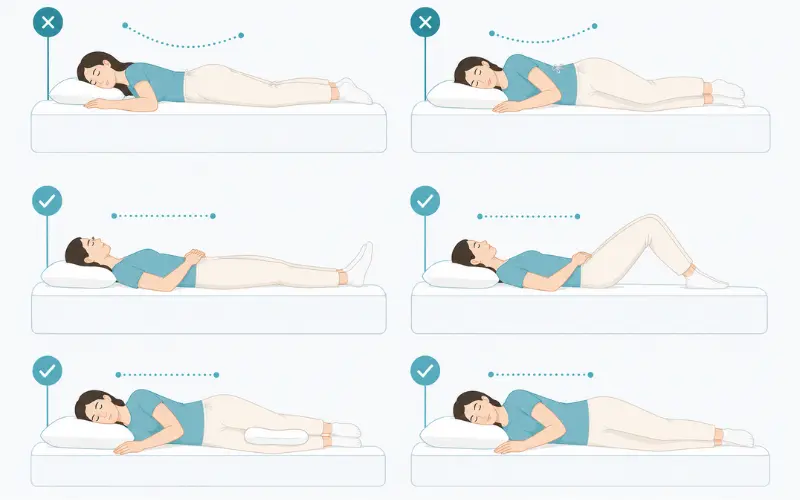
In just a few minutes, you can find your perfect pillow loft. A helper and a ruler are required. The aim is to have a straight line from the spine through the neck to the head. Follow these steps:
- Lie down in your normal sleep position. Sleep on the same mattress every night. Use your normal pillowcase.
- Have a helper look at your neck from the side. Or take a photo. Your neck should be in line with the top of your spine.
- Read the angle. If the head is tilted up, the loft is too high. If your head is dropping down, the loft is too low.
- Perform the position test. Side sleepers: the nose should be in line with the middle of the chest. Back sleepers: the chin should be in line.
- Check the size of the pillow under your head. That is your effective loft, or the height that is compressed. It is the number you aim to spend when shopping.
- Allow a new pillow to rest for 2 weeks. It takes your neck muscles approximately that long to adapt. Don’t make fit judgments on night one.
Pro tip: Do not trust the in-store feel. Press the pillow down with your hand to copy your head’s weight. Then measure the height of that. That is the loft your neck will really get.
Common Pillow Loft Mistakes
There are a few simple things that destroy good sleep. These are the most common ones we observe:
- Purchasing according to feel rather than height. Even with a soft pillow, it can be too high or too low.
- Taking the shelf number on faith. Always consider effective loft, not static loft.
- Ignoring your shoulders. Charts do not provide enough lift for broad shoulders.
- Forgetting the mattress. A new soft bed may cause your old pillow to be too high.
- Judging too fast. Wait two weeks to see how your neck feels before switching again.
- Maintaining a dead pillow. A flat pillow won’t be a lofty pillow again.
In short: These are the 6 habits that cause most pillow loft issues. Change the habits – change the pillow.
Signs Your Pillow Loft Is Wrong
Your body will let you know if your pillow loft is not right. It’s typically sensed before it’s observed. Look for the following symptoms:
- Pain or stiffness in the neck that improves during the day.
- A sore shoulder or upper back when you wake up. This is usual when the loft is too low to sleep on the side.
- Headaches that begin at the back of your head.
- Constant pillow-punching. Fluff and fold all night to find a good height.
- Pinched neck with tingling or numbness in arms.
- Progressive increase in snoring, possibly as a result of a head position that is too far forward.
Another loft problem is a flat pillow. Fold in half and release. If it does not bounce back, then the support is lost.
To sum up: don’t suffer with a bad pillow.
How to Fix or Adjust Your Pillow Loft
A new pillow isn’t always necessary. In some cases, it is possible to repair the pillow loft you have. These are some easy moves to try out first.
For a low pillow, place a thin pillow or a folded towel under it. If the pillow has a zipper to remove fill, do so to lower the pillow. Another option is to choose a lighter-weight pillowcase. If the pillow is firm and it’s too high, allow it to break in for 2 weeks. If your pillow is too low, fluff it up before going to sleep and consider replacing it more often.
The bottom line: minor patches can provide time. However, if the fill is not alive, then replace the pillow. There is no trick to get back to the loft.
Adjustable Loft Pillows
Adjustable height loft pillows stop the guesswork of height. They are equipped with a zippered cover and removable insert. Fill typically consists of shredded memory foam, shredded latex or down alternative. Fill is added or removed to gain the desired loft. The pillow insert allows you to adjust by handfuls.
It’s more important than it seems. The study on loft and neck pain revealed that allowing individuals to adjust the loft reduced their neck pain. Adjustable pillows are good for combination sleepers and wide-shouldered side sleepers. They also assist anyone who is sandwiched between two loft bands.
Some take it a step further by offering a dual loft or a two-in-one design. They present you with two sides that are at different heights. You turn the pillow from one side to the other or vice versa. These are a bit more expensive. However, most people find that controlling their loft is worth it. Check out our tried-and-tested recommendations for the best adjustable pillow.
How to Care for Your Pillow and Keep Its Loft
When you take good care, your loft will last longer. Some simple practices can make all the difference.
Shake out the pillow in the morning to set it back in place. Ventilate occasionally to prevent moisture. Place a pillow protector underneath the case to prevent sweat and oils from getting in. Wash the pillow a few times a year, according to the care label. Dry it completely, as clumps of damp kill the loft.
No matter how well cared for, all pillows will eventually wear out. Synthetic pillows typically last 1-2 years. Latex and memory foam can last for 2-3 years or longer. If the fold test fails, it’s time. Check out our pillow replacement guide for a complete schedule.
Conclusion
The pillow loft is the secret to a good night’s sleep. If the height is correct, your neck will be in a neutral position throughout the night. Rising loose, not stiff. If you get it wrong, even the best mattress will not save you!
Begin in your sleeping position. Side sleepers should use high loft (4-6 in), back sleepers medium loft (3-5 in), and stomach sleepers low loft (less than 3 in). Then adjust for your shoulders, body weight, mattress, and fill. Keep in mind the main thing – it’s the loft, or the height under your head, not the number on the box.
Not sure where you are at? With an adjustable pillow, the guesswork is eliminated. One thing we see over and over: People think the mattress is the problem, and the solution is the pillow loft. Tonight, try out the alignment test with your pillow. Your loft is overdue for a makeover if your neck isn’t straight.
FAQ
If your pillow loft is too high, your head will tilt towards your chest. Your neck is bent up all night. You tend to wake up with a stiff neck or tension headache. Lying on your side, if your nose is pointing up, the loft is too high.
Both are good by themselves. The best loft for neck pain will vary based on the way you sleep. High loft is needed for side sleepers. Medium is best for back sleepers. Low is the best for stomach sleepers. The incorrect loft in either direction puts stress on your neck.
Yes, using an adjustable pillow. Removable fill (typically shredded foam or down alternative) is contained inside a zippered cover. Fill is added or removed to adjust your height. If the pillow is fixed, place a thin pillow under it to lift it.
The height of the pillow is the loft. Firmness is the degree of firmness or softness. Pillows can be high loft and soft, or low loft and firm. Loft sets your spine alignment. Firmness creates the feel under your head.